Sample Business Contracts
Master Sales Agreement - TeleCommunication Systems Inc. and Vonage Network Inc.
Free Supply Agreement Forms
Sponsored Links
TeleCommunication Systems, Inc.
Master Sales Agreement
This Agreement is made on this 8th day of June 2005 (the “Effective Date”) by and between TeleCommunication Systems, Inc. a Maryland corporation with offices at 275 West Street, Annapolis, Maryland 21401 (“TCS”), and Vonage Network Inc., a Delaware Corporation, with offices at 2147 Route 7, Edison, New Jersey 08817 (“Customer”). TCS and Customer shall also be referred to as the “Parties” and each as a “Party”) to this Agreement.
The Parties agree as follows:
1. SCOPE OF AGREEMENT
1.1 This Master Sales Agreement is a framework agreement. TCS may sell, and Customer may purchase, Hardware, Systems, and Services and/or TCS may license Software to Customer, as specified in one or more Work Orders signed by TCS and the Customer, referencing this Master Sales Agreement and the General Statement of Work. Each such Work Order, together with the Master Sales Agreement and the General Statement of Work, shall constitute an agreement between the Parties (the “Agreement”).
1.2 The General Statement of Work shall constitute and be called Exhibit A to the Master Sales Agreement and is hereby incorporated and made a part of this Agreement.
1.3 In the event of a conflict between the terms of the Master Sales Agreement or General Statement of Work and a Work Order, the terms of the Work Order shall take precedence to the extent that they are not preprinted terms; but the terms of the Master Sales Agreement or General Statement of Work shall take precedence over any preprinted terms in a Work Order. In the event of a conflict between the terms of the Master Sales Agreement and the General Statement of Work, the General Statement of Work shall take precedence.
2. DEFINITIONS
The following terms used in this Agreement shall have the meanings stated in this Section 2:
2.1 “Affiliate” of a Party means any entity that, directly or indirectly, controls, is controlled by or is under common control with, the Party.
2.2 “Completion Criteria” means Customer’s acceptance of the Product or Service as demonstrated by Customer’s signature of the First Office Application (FOA) certificate which acknowledges the fulfillment by TCS of the obligations described in the Statement of Work, such as the delivery of a System.
2.3 “Hardware” means equipment or machines, such as computers sold and/or maintained by TCS under this agreement. Hardware may be manufactured by TCS or by third parties.
2.4 “Products” mean Hardware, Software, or Systems sold or licensed by TCS.
2.5 “Service” means performance of a task or project, provision of advice, assistance, or use of a resource (such as access to an information data base) that TCS makes available. Services include provision of maintenance and support for Products. “Professional Services” mean engineering, design or consulting services performed from time to time on a task or project basis by TCS for Customer.
TeleCommunication Systems, Inc. and Vonage Network Inc. Confidential
Pages where confidential treatment has been requested are stamped, "Confidential treatment has been requested. The redacted material has been separately filed with the Commission." All redacted material has been marked by an asterisk (*).
1
2.6 “Software” means computer programs and data, in machine readable form, and related materials, including user, technical, and system administrator materials, listings, and documentation related to such computer programs and data. Unless otherwise specified in a Statement of Work or other document signed by TCS and Customer, all Software is only licensed to the Customer and provided only in object code form. Software may be licensed by TCS or by a third party.
2.7 “Specifications” mean the technical and operational specifications that describe the proper functioning of any Product or Service. For Hardware the Specifications are provided by the manufacturer. For Services and Systems the Specifications are provided in the Statement of Work. For TCS Software, the Specifications are as provided in the License Agreement and any applicable Statement of Work. For third party Software, the Specifications are as provided in the License Agreement.
2.8 “General Statement of Work” means the document headed with that name specifying the overall respective responsibilities of TCS and the Customer for VoIP E9-1-1.
2.9 “System” means a combination of Hardware and Software integrated to perform specified functions.
2.10 “Work Orders” means a document referencing this Master Sales Agreement and the General Statement of Work and signed by both Customer and TCS specifying the Products and/or Services to be provided, the respective responsibilities of TCS and the Customer, the applicable schedule of delivery, the Completion Criteria, the applicable charges for the Products and/or Services, and any other terms.
3. PRODUCTS AND SERVICES PROVIDED
3.1 TCS shall provide the Products and Services described in each Work Order, including attachments, for the prices and on the schedules specified therein and in accordance with the Master Sales Agreement and General Statement of Work and any exhibits to either of them referenced in the Work Order.
3.2 TCS and Customer shall each perform their respective obligations and carry out the responsibilities as described and according to schedules specified in each Work Order. To the extent either Party is delayed in performing any of its obligations under the Agreement due to the other Party’s failure to perform any of its responsibilities in accordance with the applicable schedules, the first Party shall be permitted to delay the performance of its obligations and shall be entitled to compensation from the other Party for any additional actual and reasonable out-of-pocket costs incurred as a result. In the event of delay by Customer, TCS will prepare a change order of the costs associated with the delay. TCS will not continue performance of its obligations until Customer has approved the change order and amended the Work Order to include such costs. In the event of a delay by TCS, TCS will compensate Customer for such delay as set forth in the applicable Work Order or General Statement of Work.
4. ACCEPTANCE
4.1 Products and Services delivered by TCS shall be considered accepted by the Customer upon completion of the Completion Criteria, as defined in Article 2.1. If Customer has not signed the FOA within 30 business days of receipt, Products and/or Services will be deemed accepted unless Customer has provided TCS written notice of rejection detailing the reasons why they do not meet the specifications in the SOW. TCS shall promptly correct any such deficiencies or obtain the Customer’s written agreement to a plan to correct such deficiencies. The System shall thereafter be considered accepted upon completion of the Completion Criteria.
2
4.2 If Customer believes that TCS has not provided a Professional Service in a workmanlike manner or according to the Specifications of the Work Order, Customer shall provide written notice to TCS of any deficiencies within ten (10) business days of the completion of the provision of the Professional Service. TCS may perform again or provide an appropriate credit for any Professional Service that was not delivered in a workmanlike manner or according to its Specifications of the Work Order.
4.3 Customer shall own all title and interest in all Hardware delivered under this Agreement, unless such Hardware is subject to the terms of a leasing agreement.
5. INVOICES AND PAYMENT
5.1 Customer shall pay the amounts indicated in the Work Order for the Products and Services delivered by TCS. TCS may invoice the Customer for the amounts specified in the Work Order for Products and Services only upon their acceptance. Customer shall pay TCS the full amount of such invoices (other than amounts subject to a good faith dispute) in U.S. Dollars within 30 days of the date of Customer’s receipt of the invoice (“Due Date”). Except for any amounts reasonably disputed by Customer in writing, TCS may assess and Customer shall be liable to pay a late charge at a rate of one-half percent (0.5%) per month or the highest rate permitted by law, whichever is less, on all unpaid amounts (other than disputed amounts) from the due date until paid in full.
5.2 Failure to pay any fees or other charges or amounts (including taxes) due to TCS on or before the Due Date shall be a breach of this Agreement (“Failure to Pay”). Notwithstanding anything else contained in this Agreement, in the event of a Failure to Pay that is not cured within fifteen (15) business days after notice thereof, TCS may suspend delivery of Products and/or Services to Customer and/or upon five (5) business days written notice terminate this Agreement for default, unless said Failure to Pay is based on Customer’s good faith dispute of the amounts invoiced as presented in writing to TCS on or before the Due Date or the expiration of the fifteen (15) day notice period referenced above. Any suspension may be continued until the Failure to Pay has been cured but will cease upon cure. TCS shall be entitled to recover reasonable costs incurred prior to termination and attorney’s fees and costs in the event that any legal proceeding is brought by TCS in collecting all unpaid and undisputed amounts hereunder.
5.3 If Customer disputes any part of an invoice, then in order to withhold such amount from its payment, Customer must notify TCS in writing as to the specific amounts contested and the reasons for such dispute on or before the Due Date of the invoice, provided that this provision does not waive Customer’s right to subsequently place in dispute and seek a refund of amounts already paid.
5.4 All prices and charges for Products and Services provided hereunder are exclusive of any taxes applicable to the transaction, such as value added taxes, sales or use taxes, duties, or other taxes or levies imposed by any government, public authority, or government agency on Customer’s purchase of Products or Services hereunder, all of which are the responsibility of Customer to pay, provided, for avoidance of doubt, that Customer shall not be responsible for payment of any taxes based on the income, property or employment of TCS.
5.5 TCS reserves the right to modify its price for annual maintenance and support of any Products for any maintenance renewal period subsequent to the period or periods specified in the Work Order for the reasons set forth below by providing Customer notice of any price modification at least sixty (60) days prior to the commencement of the next applicable renewal period for maintenance services. Price modifications may be based on a change in the number of unique records being managed and any additional features being used by the Customer (unique records managed include all records active for any period of time during each month, regardless of service change or termination) or on Customer-initiated changes to the configuration of the Customer’s Software.
3
6. TERM AND TERMINATION OF AGREEMENT
6.1 Subject to paragraph 6.3 below, this Agreement shall be effective upon signature by both Parties as of the date noted above for a period of three (3) years (“Initial Term”) and shall be automatically extended for additional one (1) year periods, unless either Party notifies the other to the contrary no less than sixty (60) days prior to the expiration of the Initial Term or any extension thereof. The expiration of this Agreement shall not terminate any Work Order referring to the terms of the Master Sales Agreement, and the terms of the Master Sales Agreement shall remain effective as to any such Work Order, until that Work Order has been completed or has terminated.
6.2 Either Party may terminate this Agreement and any Work Order for cause upon written notice to the other Party in the event that the other Party fails to perform any of its material covenants or obligations contained in this Agreement or such Work Order, unless such default is cured or a mutually agreed plan to cure is accepted within thirty (30) days of delivery of written notice of such default to the defaulting Party. If Customer is in material default of this Agreement and such default continues for a period of thirty (30) days after TCS’ written notice thereof to Customer, then TCS shall also have an independent and alternative right to suspend delivery of Products or Services in then effective Statements of Work upon written notice to Customer, provided that TCS will end such suspension upon cure of the default by Customer. Customer may terminate this Agreement and any Work Order upon written notice to TCS if TCS assigns this Agreement or all or a substantial part of the infrastructure used to provide Services hereunder, directly or through the sale or merger of TCS or any of its assets, to an entity that has a substantial business in VOIP services.
6.3 The Parties agree that in the event that material unforeseen changes in applicable legal or regulatory requirements for providing VoIP E9-1-1 services make the provision of Services under this agreement commercially impracticable or materially impact the cost of acquiring or delivering such services for either Party, then the Parties will negotiate in good faith to adopt changes to or revisions of the Services contemplated by this Agreement so that such legal or regulatory changes are not unreasonably burdensome on either Party. If after good faith negotiations the Parties do not agree to amend this Agreement or the Services to accommodate such legal or regulatory changes, then either Party may terminate this Agreement and any Work Order upon ninety (90) days written notice to the other Party.
Customer’s license to any Software shall become effective upon acceptance by Customer of the Software or a System that includes the Software. If this Agreement expires or terminates (other than for reason of Customer’s default), Customer’s license to Software shall continue in accordance with the terms of the applicable TCS Software License Agreement or third party license. If this Agreement and the Customer’s license to use the Software is terminated by TCS pursuant to Section 5.2 for a Failure to Pay or Section 6.2 for a material default by Customer, Customer shall be entitled to retain possession of and to continue to use the Software for a period not to exceed 45 days in order for Customer to make a transition to alternate software or facilities.
This Agreement and any Work Order referencing this Agreement may also be terminated by either Party, if the other Party has become insolvent, has filed for bankruptcy, or has been declared insolvent or bankrupt.
Any termination pursuant to Section 6.2, 6.3 or 6.5 shall be without liability on the terminating Party, provided that such termination will not relieve the terminating Party for amounts owed with regard to Services rendered prior to the effective date of such termination.
The following terms of this Agreement shall survive expiration or termination of this Agreement: Articles 5, 6, 8, 9, 12, 14, and 16.
4
7. WARRANTY AND MAINTENANCE OF PRODUCTS
TCS Products delivered to Customer under this Agreement are warranted to conform to their Specifications for a period of one year after acceptance by Customer (or for such other period as may be set forth in the Work Order). During the warranty period, TCS will correct defects in Software and repair or replace Hardware in accordance with third party manufacturer’s policies and in the event TCS fails to do so within thirty (30) days of notice of such defect, will refund amounts paid by Customer for the defective Hardware or Software prorated for the remaining term of the warranty period. Following such warranty period, TCS shall provide Customer with maintenance and support services for Software and Hardware in accordance with the terms of the TCS Product Maintenance Support Policy, Exhibit B (to be attached only if Software license and Hardware are to be purchased under a Work Order), for the periods Customer requests and pays for such maintenance and subject to any additional terms specified in the applicable Work Order. For all third party Hardware and Software delivered by and purchased through TCS, Customer will be provided warranty and maintenance service in accordance with the third party manufacturer’s warranty and maintenance policies, provided Customer pays any applicable maintenance support charges which are quoted to and approved by Customer in advance of the rendering of such warranty and maintenance service.
TCS MAKES NO OTHER WARRANTIES OF ANY KIND WITH RESPECT TO THE PRODUCTS AND SERVICES PROVIDED UNDER THIS AGREEMENT. EXCEPT AS EXPRESSLY PROVIDED IN THIS AGREEMENT, TCS MAKES NO OTHER WARRANTIES, EXPRESS OR IMPLIED, INCLUDING IMPLIED WARRANTIES OF MERCHANTABILITY AND FITNESS FOR A PARTICULAR PURPOSE.
8. INTELLECTUAL PROPERTY NON-INFRINGEMENT AND INDEMNIFICATION
8.1 TCS represents and warrants as of the effective date of this Agreement and thereafter throughout the term of this Agreement that TCS owns or has the legal right to license the Software licensed under this Agreement and that the Software does not infringe any patent, copyright, or trademark of any third party enforceable in the United States. TCS further represents and warrants that no Hardware or Software delivered to Customer and no System contains any (i) back door, time bomb, or other software routine designed to disable a computer program automatically with the passage of time or under the positive control of TCS; or (ii) any virus, Trojan horse, worm, or other software routine or hardware component designed to permit unauthorized access to, disable, erase, modify or otherwise harm any software, hardware or data; provided that with regard to third party Hardware or Software, the representation and warranty in this sentence is made only to TCS’ best knowledge and belief.
8.2 If a third party claims that any of the Software, Hardware, Systems or Service infringes its patent, copyright, or trademark enforceable in the United States, TCS will indemnify and defend Customer against that claim at TCS’ expense, provided that Customer promptly notifies TCS in writing of the claim (provided that failure or delay in making such notification shall excuse TCS from its indemnification obligation hereunder solely to the extent that TCS is actually prejudiced thereby), allows TCS to control the defense of such claim, and cooperates with TCS in its defense. If such a claim is made, Customer agrees to permit TCS to, and TCS will at its own expense, either: 1) procure necessary rights to enable Customer to continue to use the Software, Hardware, Systems or Service, or 2) modify or replace such Software, Hardware, Systems or Service to eliminate the infringement; provided that the choice between (1) and (2) shall be at TCS’ discretion. However, TCS has no obligation of indemnification under this Section 8.2 for any claim of infringement caused by Customer’s modification of the Software or Service or their combination, operation, or use with any product, data, or apparatus not specified or provided by TCS, provided that such claim would be avoided absent such Customer modification or combination, operation, or use with products, data, or apparatus not specified or provided by TCS. THIS SECTION 8.2 STATES TCS’ ENTIRE OBLIGATION WITH RESPECT TO ANY CLAIM OF INTELLECTUAL PROPERTY INFRINGEMENT.
5
8.3 The parties intend that TCS, in its performance of the Services, enjoy the same immunity from or limitation of liability as is available to Customer and its agents under applicable law in connection with the provision of the standard or enhanced 9-1-1 service and in any event, that TCS at least be indemnified against liability arising out of or relating to TCS’ performance of the Services except to the extent such liability results from the negligent, reckless, willful or wanton misconduct of TCS or its employees, agents, representatives or TCS’ breach of this Agreement (including without limitation any warranties of TCS set forth herein). Accordingly, Customer shall defend, indemnify and hold harmless TCS and its directors, officers employees, representatives, agents and third party vendors from and against any and all claims, suits, demands, actions, losses, awards, liabilities, damages, costs and expenses (including, without limitation, reasonable attorney’s fees) asserted by third parties and arising out of or in connection with (a) any act or omission of Customer or its employees, agents, representatives in the operation of its VoIP 9-1-1 service or other services; or (b) any act or omission of TCS that is reasonably undertaken for purposes of the provision and performance of the Services or its other obligations under this Agreement; provided that the foregoing indemnity will not require Customer to indemnify TCS against liability for damages to the extent such damages result from the negligence or reckless, willful or wanton misconduct of TCS or TCS’ breach of this Agreement (including without limitation any warranties set forth herein). To the fullest extent permitted by applicable law, the foregoing indemnity will apply regardless of any strict liability or product liability of TCS not amounting to negligent, reckless, willful or wanton misconduct of TCS or TCS’ breach of this Agreement (including without limitation any warranties of TCS set forth herein).
8.4 TCS shall defend, indemnify and hold harmless Customer and its directors, officers employees, representatives, agents and third party vendors from and against, any and all claims, suits, demands, actions, losses, awards, liabilities, damages, costs and expenses (including, without limitation, reasonable attorney’s fees) asserted by third parties and arising out of or in connection with (a) any negligent, reckless, willful or wanton act or omission of, or breach of this Agreement by, TCS or its employees, agents, representatives; or (b) any act or omission of TCS that is not reasonably undertaken for purposes of the provision and performance of the Services or its other obligations under this Agreement; provided that the foregoing indemnity will not require TCS to indemnify Customer against liability for damages to the extent such damages result from the negligence, reckless, willful or wanton misconduct of Customer or Customer’s breach of this Agreement (including, without limitation, any warranties of Customer set forth herein).
8.5 To the extent not addressed in Section 8.3 or 8.4, each party (for purposes of this Indemnification Section, the “Indemnifying Party”) will indemnify, defend and hold harmless the other (including its officers, directors, employees and agents), its Affiliates and customers, against any loss, cost, expense or liability (including reasonable attorneys’ fees and costs) arising from the negligence or willful misconduct of the Indemnifying Party (including its Affiliates, agents, employees and others under its direction or control).
8.6 In any case in which one Party is required to indemnify the other pursuant to this section 8, the party to be indemnified pursuant to this Section 8 will notify the Indemnifying Party within a reasonable time after receiving notice of a claim (provided that failure or delay in making such notification shall excuse the Indemnifying Party from its indemnification obligation hereunder solely to the extent that the Indemnifying Party is actually prejudiced thereby). Provided that the Indemnifying Party promptly and reasonably investigates and defends any such claim, the Indemnifying Party will have control over the defense and settlement thereof. The party to be indemnified will furnish, at the Indemnifying Party’s reasonable request and expense, information and assistance necessary for such defense.
9. LIMITATION OF LIABILITY
NEITHER PARTY WILL BE LIABLE TO THE OTHER (OR ITS DIRECTORS, OFFICERS, EMPLOYEES, REPRESENTATIVES, AGENTS, SUBCONTRACTORS, CUSTOMERS OR ANY OTHER THIRD PARTY) FOR ANY INDIRECT, INCIDENTAL, SPECIAL OR CONSEQUENTIAL
6
DAMAGES ARISING OUT OF THE SERVICES OR SUCH PARTY’S PERFORMANCE OF OR FAILURE TO PERFORM ITS OBLIGATIONS UNDER THIS AGREEMENT OR (EXCEPT AS PROVIDED IN SECTION 8) FOR THE CLAIMS OF THIRD PARTIES FOR LOSSES OR DAMAGES. EXCEPT FOR AMOUNTS PAYABLE BY CUSTOMER TO TCS UNDER SECTION 5, AND THE INDEMNIFICATION OBLIGATIONS SET FORTH IN SECTION 8, EACH PARTY’S LIABILITY (WHETHER IN TORT, CONTRACT OR OTHERWISE AND NOTWITHSTANDING ANY FAULT, NEGLIGENCE (WHETHER ACTIVE, PASSIVE OR IMPUTED), PRODUCT LIABILITY OR STRICT LIABILITY OF SUCH PARTY) UNDER THIS AGREEMENT OR WITH REGARD TO THE SERVICES OR OTHER ITEMS FURNISHED UNDER THIS AGREEMENT WILL NOT EXCEED THE TOTAL COMPENSATION ACTUALLY PAID TO TCS FOR THE PREVIOUS TWELVE MONTHS UNDER SECTION 5 OR $100,000, WHICHEVER IS GREATER.
10. ASSIGNMENT
This Agreement may not be assigned or transferred by either Party without the prior written consent of the other Party, except that upon notice to the other Party: (1) either Party may assign this Agreement without consent to any Affiliate of it, and (2) TCS may assign its rights to payments under this Agreement to a financial institution. In addition, Customer’s rights under this Agreement and in the Software may be transferred, leased, assigned, or sublicensed without the consent of TCS to a successor in interest to Customer’s entire business or substantially all of its assets which assumes the obligations of this Agreement.
11. FORCE MAJEURE
Neither Party shall be liable under this Agreement for delays, failures to perform, damages, losses or destruction, or malfunction of any equipment or software, or any consequence thereof, caused by fire, earthquake, flood, water, the elements, unavailability of transportation, acts of terrorism or acts or omissions of third parties other than subcontractors of a Party, or any other cause beyond the reasonable control of a Party and not caused by its negligence (“Force Majeure”). The Party whose performance is affected by such Force Majeure shall notify the other Party of the existence of such Force Majeure and shall use its best efforts to resume performance as soon as practicable. Customer shall not be obligated to pay for any Service which TCS is unable to perform because of Force Majeure.
12. PUBLICITY AND CONFIDENTIALITY
12.1 Without the written consent of the other or unless required by law or regulatory authority, neither Party shall disclose the terms of this Agreement or any related facts to any third party except such Party’s lawyers, accountants or auditors which are obligated to keep such information in confidence. No press releases or other public announcements of or relating to this Agreement shall be made by either Party without the prior written consent of the other Party. The Parties agree to work in good faith to issue a mutually agreeable joint press release designed to coincide with general availability of the VoIP E9-1-1 services, concerning this Agreement and the work to be performed. Each Party may use the name of the other Party (without other information) in its supplier or customer lists, as applicable.
12.2 For a period of three (3) years from the date of receipt, each party shall maintain the confidentiality of and not disclose to third parties all information or data of any nature provided to it by the other party hereto provided such information (i) contains a conspicuous marking identifying it as confidential or proprietary, (ii) in the case of confidential information disclosed orally, is identified as confidential at the time of disclosure and a written summary provided to the receiving Party within fifteen (15) days of disclosure or (iii) whether or not so marked or identified if such information is related to Customer’s customer lists, financial or budgetary statements or projections, or technical, operational or business plans or strategies (“Confidential Information”). Each Party shall use the same efforts to protect from disclosure Confidential Information it receives hereunder as such Party accords to similar confidential information of its own.
7
12.3 This Agreement imposes no obligation on the Recipient with respect to Confidential Information received from the Provider which:
(a) was known to the receiving Party without any limitation on use or disclosure prior to the delivery of the Information by Provider,
(b) is independently developed by the receiving Party,
(c) is rightfully obtained by the receiving Party from a third party under no obligation of confidentiality,
(d) is made available to third parties by the disclosing Party without any limitation on use or disclosure, or
(e) is, or becomes, publicly available.
This Agreement shall not prevent any disclosure of Confidential Information to a court or government agency pursuant to a lawful order, provided that prior to making such disclosure, the receiving Party shall use reasonable efforts to notify the disclosing party of this required disclosure and shall seek or permit the disclosing Party to seek available protections against further disclosure by such court or agency.
12.4 The Parties acknowledge that a breach of any of the promises or covenants contained in this Section 12 may result in irreparable damage to the disclosing party, for which there may be no adequate remedy at law. The disclosing Party shall be entitled to seek injunctive relief and/or a decree for specific performance and such other relief as may be proper (including monetary damages if appropriate).
13. NOTICES
All notices concerning this Agreement shall be in writing and shall be deemed given upon receipt. All notices shall be sent by registered or certified mail, by overnight courier service, facsimile transmission with electronic confirmation of delivery, or by other means agreed upon by both parties. Either Party may change the names or address to which notices must be sent by sending a written notice to the other Party.
|
Notices to TCS should be sent to: |
|
TeleCommunication Systems, Inc. |
|
|
|
275 West Street, |
|
|
|
Annapolis, MD 21401 |
|
|
|
|
|
|
|
Attention: Celeste Ciecierski |
|
|
|
|
|
|
|
Tel: (410) 295-1451 |
|
|
|
Fax: (410) 263-7617 |
|
|
|
|
|
Notices to Customer should be sent to: |
|
Vonage |
|
|
|
2147 Route 27 |
|
|
|
Edison, New Jersey 08817 |
|
|
|
|
|
|
|
Attention: Brooke Schulz |
|
|
|
|
|
|
|
Tel: (732) 528-2627 |
|
|
|
Fax: (732) 287-9119 |
8
14. DISPUTES
The Parties agree to submit to arbitration for any and all matters in dispute or controversy between them concerning this Agreement that cannot be resolved through discussion by senior executives of both Parties. In the event that discussions by senior executives cannot resolve any such dispute or controversy within sixty (60) days (or such other longer period as the Parties may agree) either Parties may submit such matter in dispute to arbitration, and such matter shall be resolved by a binding arbitration by a single arbitrator. Any such arbitration proceeding shall be held in the English language in New York, New York. The arbitrator will be selected and the arbitration conducted in accordance with the Commercial Arbitration Rules of the American Arbitration Association. The parties will share equally in the fees and expenses of the arbitrator and the cost of the facilities used for the arbitration hearing, but will otherwise bear their respective costs incurred in connection with the arbitration. The parties agree to use all reasonable commercial efforts to ensure that the arbitrator is selected promptly and that the arbitration hearing is conducted no later than three (3) months after the arbitrator is selected. The arbitrator may not award punitive or exemplary damages against any Party or any other relief in excess of the limitations set forth herein. The arbitrator’s award shall adhere to the plain meaning of this Agreement and to applicable law, and shall be supported by written findings of fact and conclusions of law. The judgment and award of the arbitrator will be final and binding on each Party. Judgment upon the award may be entered in any United States federal or state court having jurisdiction.
15. INSURANCE
15.1 TCS shall maintain, during the term of this Agreement, at its own expense, the following insurance:
15.1.1 Worker’s Compensation and related insurance as prescribed by the law of the state in which the work is performed; and
15.1.2 Comprehensive general liability insurance and, if the use of automobiles is required, comprehensive automobile insurance, each with limits of at least USD $2,000,000 for combined single limit for bodily injury, including death, and/or property damage.
16. MISCELLANEOUS
16.1 Neither Party shall perform or use the TCS Products or Services in any manner nor for any purpose which violates the laws or regulations of the jurisdiction in which the TCS Products or Services are being provided.
16.2 Customer shall not perform any service bureau work, grant multiple-user licenses, or enter into any time-sharing arrangements using Software licensed under this Agreement, except as expressly authorized in writing by TCS, provided that Customer’s use of the software in providing service to its customers shall not be deemed to violate this Section 16.2.
16.3 Any provision or provisions of this agreement which in any way contravenes the law of any jurisdiction in which this Agreement is effective shall, in such jurisdiction, to the extent of such contravention of law, be deemed severable and ineffective. Such severance shall not affect any other provision hereof or the validity of this Agreement, unless one or more essential purposes of the Agreement is rendered ineffective, in which case either Party may terminate the Agreement without cause in that jurisdiction by notice to the other Party within a reasonable period.
16.4 No waiver by either Party to any provisions of this Agreement shall be binding unless made expressly and confirmed in writing. Any such waiver shall relate only to such matter, non-compliance or breach as it relates to and shall not apply to any subsequent or other matter, non-compliance or breach.
9
16.5 The relationship between and among the Parties hereto shall be that of independent contractors only, and without limiting the foregoing shall not be that of partners. Nothing herein contained shall be deemed to constitute a partnership between and amongst them, merge their assets, or their fiscal or other liabilities or undertakings. Nothing herein contained shall allow a Party to act as an agent of any other party, except that TCS may be considered a limited agent of Customer when TCS is acting on the behalf of and at the direction of the Customer for the limited purpose of transmitting E9-1-1 data to Public Safety Answering Points (PSAPs). TCS shall be solely responsible for its own employees, including without limitation with regard to their employment, compensation, benefits and taxes relating to their employment. No TCS employee shall be deemed to be an employee of Customer for any purpose.
16.6 This Agreement, (which includes Exhibit A) sets forth the entire agreement and understanding between the Parties with respect to the subject matter hereof and merges, supersedes, terminates and otherwise renders null and void any and all prior discussions, negotiations and agreements between them. Neither of the Parties shall be bound by any conditions, definitions, representations or warranties with respect to the subject matter of this Agreement other than as expressly provided herein.
16.7 This Agreement, and all the rights and duties of the Parties arising from or relating in any way to the subject matter of this Agreement or the transaction(s) contemplated by it, shall be governed by, construed and enforced in accordance with the laws of the State of New York (excluding any conflict of laws provisions of the State of New York that would refer to and apply the substantive laws of another jurisdiction). To the extent court action is initiated to enforce an arbitration award or for any other reason consistent with Section 14, the Parties agree to submit to the personal and exclusive jurisdiction of the courts located within the state of New York and waive any objection as to venue or inconvenient forum.
16.8 For a period of one year from the termination of this Agreement, Customer and TCS each agree not to solicit the employment of any employee or consultant of the other Party who has been directly involved in the performance of services under this Agreement; provided that the employment of an employee of the other Party who replies to a general advertisement or employment listing not specifically targeted to employees of the other Party shall not be prohibited by this Section 16.8.
10
By its signature below, each Party signifies its agreement to the foregoing.
AGREED:
|
TeleCommunication Systems, Inc. |
CUSTOMER | |||
|
|
| |||
|
|
| |||
|
BY: |
/s/ Richard A. Young |
|
BY: |
/s/ John S. Rego |
|
Signature |
Signature | |||
|
|
| |||
|
Richard A. Young |
|
John S. Rego | ||
|
Name |
Name | |||
|
|
| |||
|
Exec. VP & COO |
|
CFO | ||
|
Title |
Title | |||
|
|
| |||
|
June 8, 2005 |
|
6-8-05 | ||
|
Date |
Date | |||
Attachments:
Exhibit A: General Statement of Work (To be mutually agreed and incorporated by amendment to the Agreement)
Exhibit B: VoIP i1 9-1-1 Statement of Work
11
TeleCommunication Systems, Inc.
Western Office
2401 Elliott Avenue, Second Floor
Seattle, WA 98121
Phone 206-792-2000
Fax 206-792-2051
www.telecomsys.com
TeleCommunication
Systems
Enabling Convergent Technologies®
TCS VoIP E9-1-1
Exhibit A General Statement of Work
For Vonage Network Inc.
7/1/2005
CONFIDENTIAL & PROPRIETARY
Limited Distribution to Authorized Persons Only
Created 2005 and Protected as an Unpublished Work
Under the US Copyright Act of 1976.
Copyright © 2005 Telecommunication Systems Inc
All Rights Reserved.
1
Contents
|
|
|
|
Page | ||
|
1. |
INTRODUCTION |
|
3 | ||
|
2. |
VoIP E9-1-1 TECHNICAL SERVICE OVERVIEW |
|
4 | ||
|
|
2.1 |
TECHNICAL SERVICE OVERVIEW |
|
4 | |
|
|
2.2 |
TCS’ VoIP E9-1-1 SERVICE COMPONENTS |
|
4 | |
|
|
2.3 |
VONAGE’S VoIP E9-1-1 SYSTEM COMPONENTS |
|
5 | |
|
|
2.4 |
GENERAL SERVICE SPECIFICATION |
|
5 | |
|
|
|
2.4.1 |
Connectivity |
|
5 |
|
|
|
2.4.2 |
Subscriber Provisioning |
|
6 |
|
|
|
2.4.3 |
Subscriber Location Information Validation |
|
6 |
|
|
|
2.4.4 |
Subscriber Location Database |
|
7 |
|
|
|
2.4.5 |
Call Signaling |
|
7 |
|
|
|
2.4.6 |
Operator Routing Support Service |
|
7 |
|
|
|
2.4.7 |
Service Confirmation |
|
8 |
|
|
|
2.4.8 |
Reporting |
|
8 |
|
|
2.5 |
i1 SERVICE SPECIFICATION |
|
9 | |
|
|
|
2.5.1 |
Call Routing |
|
9 |
|
|
|
2.5.2 |
Call Delivery |
|
9 |
|
|
|
2.5.3 |
Data Delivery |
|
9 |
|
|
|
2.5.4 |
Default Routing |
|
9 |
|
|
2.6 |
i2 SERVICE SPECIFICATION |
|
10 | |
|
|
|
2.6.1 |
Call Routing Flow |
|
10 |
|
|
|
2.6.2 |
Call Delivery |
|
12 |
|
|
|
2.6.3 |
Data Delivery |
|
12 |
|
|
|
2.6.4 |
Default Routing |
|
13 |
|
3. |
VoIP E9-1-1 PROGRAM MANAGEMENT OVERVIEW |
|
14 | ||
|
4. |
DEPLOYMENT SERVICES FOR i2 MARKET LAUNCH |
|
15 | ||
|
|
4.1 |
GENERAL PROJECT |
|
15 | |
|
|
4.2 |
MARKET LAUNCH |
|
15 | |
|
|
4.3 |
PSAP OUTREACH |
|
15 | |
|
|
4.4 |
PSAP DEPLOYMENT WORK |
|
16 | |
|
|
|
4.4.1 |
Assumptions |
|
16 |
|
|
4.5 |
DATA PROVISIONING |
|
17 | |
|
|
4.6 |
TESTING |
|
17 | |
|
|
4.7 |
GO-LIVE |
|
17 | |
|
|
4.8 |
DEPLOYMENT SCHEDULE |
|
17 | |
|
|
4.9 |
DEPLOYMENT ACCELERATION |
|
18 | |
|
|
4.10 |
DEPLOYMENT FIRST MOVER ADVANTAGE |
|
18 | |
|
|
4.11 |
DEPLOYMENT APPROACH |
|
18 | |
|
5. |
TCS VoIP E9-1-1—OPERATIONAL SERVICES OVERVIEW |
|
18 | ||
|
|
5.1 |
FACILITIES |
|
19 | |
|
|
|
5.1.1 |
Data Centers |
|
19 |
|
|
|
5.1.2 |
Network Operations Centers |
|
19 |
|
|
|
5.1.3 |
Technical Support |
|
20 |
|
|
|
5.1.4 |
Monitoring |
|
20 |
|
|
|
5.1.5 |
Data Maintenance |
|
21 |
|
6. |
MILESTONES FOR SERVICE LAUNCH |
|
21 | ||
|
7. |
SERVICE LEVEL AGREEMENT |
|
22 | ||
|
8. |
PRICING AND BILLING |
|
22 | ||
|
9. |
AGREED: |
|
22 | ||
2
1. Introduction
This document is Exhibit A to the Master Sales Agreement (“MSA”) between TCS and Vonage dated June 8, 2005, describes the TCS VoIP e9-1-1 Service to be provided by TCS to Vonage thereunder, explains how the TCS VoIP E9-1-1 Service will work from a technical, deployment, and operational perspective, and sets forth the parties’ respective roles and responsibilities with regard thereto.
The document begins with a “Technical Overview” section, which describes the system components and the implementation options available. This is followed by the “Program Management Overview,” which identifies TCS’ services and roles during initial launch of services and during creation of MSAGs for Vonage. The next major section is the “Operational Services Overview,” which details TCS’ roles and responsibilities while operating the VoIP E9-1-1 Solution.
Pricing for the VolP E9-1-1 Solution also is attached to this document.
TCS and Vonage entered into a letter agreement with an Effective Date of May 31, 2005 (the “Letter Agreement”) which provided for the completion a Demonstration Project of the TCS VoIP E9-1-1 service. (Terms in this paragraph which are capitalized and not otherwise defined refer to terms defined in the Letter Agreement.) The Letter Agreement, by its terms, will expire on July 1, 2005, but the Demonstration Project has not been completed due to circumstances mutually understood between TCS and Vonage. Both parties have agreed to enter into this Exhibit A in order to initiate certain other activities required for full deployment of the service, but with the contingency that if the Demonstration Project does not successfully complete the Acceptance Criteria set forth in Exhibit B of the Letter Agreement by July 15, 2005, then this Exhibit A to the MSA shall become null and void, and the rights and obligations of both TCS and Vonage shall be the same as though this Exhibit A to the MSA was never executed.
3
2. VoIP E9-1-1 Technical Service Overview
This section describes the technical scope of the TCS VoIP E9-1-1 Service and defines the respective scope of responsibility for TCS and Vonage. Activities or functions described in this Statement of Work as Vonage responsibilities may be undertaken by a third party on behalf of Vonage upon express written authorization by Vonage. Upon receipt of such authorization, TCS will be entitled to deal with such third party for the purposes set forth in such authorization, and will deal with such third party pursuant to Vonage’s written instructions.
2.1 Technical Service Overview
The TCS E9-1-1 VoIP Service will support static, nomadic, and mobile VoIP subscribers. TCS will provide to Vonage both an i1 and an i2 solution as specified below in sections 2.5 and 2.6, respectively.
2.2 TCS’ VoIP E9-1-1 Service Components
TCS will provide the following components as part of the TCS VoIP E9-1-1 Service:
|
Component |
|
Description |
|
Business to Business (B2B) Provisioning Interface |
|
The TCS B2B interface currently supports and will continue to support civic address validation whereby the provided address is compared against geographic data (e.g., street name, city, state, ZIP), and provisioning of the subscriber address into the SLDB. The B2B interface is based on Simple Object Access Protocol (“SOAP”). |
|
Validation Database (VDB) |
|
Provides a validation interface to the SLDB using Master Street Address Guide (MSAG) data and GIS layer data. The VDB provides both civic and MSAG data validation. Delivery of the MSAG files is the responsibility of the ESGW provider. |
|
|
|
MSAG validation will be made available by TCS in |
|
Subscriber Location Database |
|
Stores subscriber location information for use by the VPC. |
|
Service Order Input Database (SOIDB) |
|
Used for provisioning MSAG valid shell records into the ALI database and provisioning ESQKs into the selective router. |
|
VoIP Positioning Center (VPC) |
|
Provides call routing instructions to Vonage’s VoIP network and delivers caller location information to the ALI/PSAP. |
|
Emergency Routing Database (ERDB) |
|
Identifies the Emergency Services Number (ESN), ESQK Pool, Selective Router, and Contingency Routing Number (The 10-digit, PSAP 7x24 emergency number; used if call cannot be routed through the selective router). |
|
ALI Link |
|
Integrates the VPC with V-E2, NENA2, and PAM compliant ALI databases nationally. |
|
Operator Routing Support Service (ORSS) |
|
If Vonage chooses TCS ORSS service, calls that the VPC cannot automatically route to a PSAP will be answered by a call taker and transferred to the appropriate PSAP or first responder. The PSTN connectivity to the ORSS the responsibility of Vonage. |
|
|
|
ORSS available June 30, 2005 |
|
Reporting Web |
|
A secure, customer-facing web-based reporting interface. |
4
2.3 Vonage’s VoIP E9-1-1 System Components
To complete the solution, Vonage must provide the following components:
|
Component |
|
Description |
|
Provisioning Server |
|
Provides location provisioning interface to VoIP Subscriber and relays subscriber location information to the SLDB via the B2B Provisioning Interface. |
|
9-1-1 Call/Proxy Server (Soft Switch): |
|
Interacts with VPC to obtain and interpret location-based call routing instructions. |
|
Emergency Services Gateway (ESGW): |
|
Routes 9-1-1 calls to the Selective Router via trunks between ESGW and Selective Routers or via trunks to tandem switches which connect to Selective Routers |
Both the TCS-provided and Vonage-provided components will use NENA standard interfaces (as set forth in section 2.4.5 below) where applicable. The following diagram represents the solution system components:

2.4 General Service Specification
2.4.1 Connectivity
Vonage will connect to TCS as mutually agreed. The parties’ respective responsibilities are set forth below.
|
TCS |
|
Vonage |
|
• Supports connectivity via a pair of dedicated circuits as mutually agreed. |
|
• Works with TCS Engineering to identify connectivity-specific information. |
5
|
• Orders geographically and carrier redundant circuits between Vonage and TCS. |
|
• Provides support during circuit turn-up. |
|
• Provides support during circuit turn-up. |
|
|
|
• Monitors circuits to ensure availability. |
|
|
2.4.2 Subscriber Provisioning
TCS will provide a single provisioning interface for all VoIP 9-1-1 Services. The provisioning process will be interactive between the end-user and the validation database. TCS will leverage its own geographic information system (the Kivera Location Engine) to integrate MSAG data into the street data. TCS will use this integrated dataset to perform both civic and MSAG validation (MSAG Validation available in 4Q05).
TCS supports and will continue to support NENA standard interfaces for subscriber provisioning. These are defined in the Interface Control Document (“ICD”) and provisioning guide identified as:
B2B: 1095-1A-Subscriber_Data_Prov_B2B_ICD_v2.1
Bulk: TCS Bulk Provisioning Guide (It is anticipated that the Bulk interface will be used only for the initial production load, and thereafter B2B will be the primary interface.)
i2 provisioning requires that records be stored in the SLDB. Upon a B2B provisioning transaction request by Vonage, TCS will manage and store SLDB records. Only shell records will be provisioned in the ALI (to enable ESQK ALI Steering). The VPC uses these SLDB records to determine routing during call flow. Furthermore, the address portion of the records is staged for the ALI query based on the assigned ESQK.
2.4.3 Subscriber Location Information Validation
Subscriber address information will be validated by TCS in real-time prior to entry into the TCS SLDB. The diagram below illustrates the validation process for customer addresses, the process for loading the ALI record, and the reporting available to Vonage. The process flow is as follows:
|
Step |
|
TCS |
|
Vonage |
|
1 |
|
N/A |
|
Vonage sends a provisioning request containing customer data (URI, TN, address) to TCS via B2B interface. |
|
2 |
|
TCS validates each address received against the TCS address validation system. November 2005 |
|
N/A |
|
3 |
|
If the address cannot be validated TCS generates detailed error codes. |
|
N/A |
6
|
4 |
|
TCS sends a response containing either a success or failure notification (and corresponding error codes and/or address alternatives) for each address. |
|
If validation fails, Vonage will facilitate troubleshooting the address with the subscriber and will resubmit records as needed. |
|
5 |
|
If validated, each address is stored in the TCS SLDB. |
|
N/A |
2.4.4 Subscriber Location Database
TCS will support subscriber provisioning through a B2B Provisioning Interface.
Vonage will provide subscriber data in the format defined in the Subscriber Data Provisioning ICD. TCS also offers a batch file submission process for initial data loads as defined in the Bulk Provisioning Guide.
2.4.5 Call Signaling
TCS supports and will continue to support NENA standard V4 and V6 interfaces for call signaling. These are defined in the Interface Control Documents. The current versions are identified below.
• 11 73-1_V4_SIP_ICD_1_1.doc
• 1 150-1_V6_SIP_ICD_1_2.doc
TCS reserves the right to modify the ICD to maintain consistency with the NENA standard interfaces, but shall not implement such modifications into the Vonage service without the approval of Vonage.
2.4.6 Operator Routing Support Service
Pursuant to this SOW, TCS will use best efforts to eliminate the circumstances in which a Vonage VoIP 9-1-1 caller is directed to a recording. Calls that the VPC cannot automatically route to a PSAP will be answered by a TCS-provided call taker and transferred to the appropriate PSAP or first responder.
If the subscriber is unprovisioned (for example, has not registered its location information and subscribed to Vonage’s 911 service), the TCS call taker will determine the caller’s location and direct the call to the correct PSAP. If the PSAP refuses calls, the call taker will use its best efforts to transfer the call either to the PSAP or directly to the appropriate responder through the 10-digit PSTN number as described in Exhibit B to the MSA.
7

2.4.7 Service Confirmation
TCS will use VoIP Verify™, a custom dialing plan, to allow users to obtain real-time PSAP service status. After dialing a designated number (for example, 9-3-3), the subscriber will hear a message describing the extent of their 9-1-1 coverage. This will help to mitigate subscriber misunderstandings about the level of service that they can expect. TCS currently supports a validation-only interface that responds to a query against a provisioned location. The query will allow users to obtain real-time PSAP service status. Vonage must provide the user interface (i.e., incorporated into the provisioning server).
TCS intends to offer service confirmation validation via an Internet-based interface which currently is scheduled for availability by the end of November 2005. If such Internet-based service is requested by Vonage upon its availability, TCS and Vonage will mutually agree upon the terms for its integration into the services provided to Vonage.
2.4.8 Reporting
TCS will provide a web based reporting server to Vonage for access to all VoIP reports and data. Through this web site, TCS will be able to report accurately on all provisioned subscribers. TCS will provide Vonage with the capability to access the following data:
|
Function |
|
Report |
|
Subscriber Provisioning |
|
• Provisioned Subscriber Detail including counts of subscribers provisioned by full address and provisioned only by city/state/ZIP, and PSAP Status • TCS VoIP Verify Utilization |
|
Service Set-up/ Data Provisioning |
|
• ESRN/ ESQK Pool Provisioning Status |
|
Call Flow |
|
• Call Counts by Subscriber • Default Routes • Call Failures • Calls handled by ORSS |
|
Deployment |
|
• PSAP Status (i1/i2) • Market Readiness |
8
2.5 i1 Service Specification
TCS will provide Vonage with a custom i1 solution, whereby all i1 calls will route to the Operator Routing Support Service (“ORSS”) as provided in Exhibit B to the MSA. The ORSS will confirm the caller’s location and route the call to the appropriate PSAP. The parties’ respective responsibilities are set forth below.
2.5.1 Call Routing
|
TCS |
|
Vonage |
|
• Provides VoIP E9-1-1 service for calls within the United States and Canada. • Provides a 10-digit 24x7 PSAP emergency number for routing the call. |
|
• Provides the call connectivity access to the PSTN. • Provides softswitch with PSTN access. |
2.5.2 Call Delivery
|
TCS/ ORSS |
|
Vonage |
|
• Confirms caller name and address. • Identifies the type of emergency. • Identifies the appropriate PSAP/ 1st Responder to handle the call. • Contacts the PSAP/ 1st responder. • Confirms call acceptance and drops from the call. • Documents call status. |
|
• Routes call via PSTN to the 10-digit number for the ORSS. • Establishes and maintains dedicated trunking between softswitch and PSTN. |
2.5.3 Data Delivery
|
TCS |
|
Vonage |
|
• Stages records in a TCS database for reporting and billing purposes. Vonage will be allowed access to the subscriber data contained in this database through the reporting server. |
|
|
2.5.4 Default Routing
As with all i1 calls, in the event that TCS receives a subscriber telephone number that is not in the SLDB, TCS will provide a 10-digit 24x7 ORSS number for routing the call. The ORSS will have the ability to validate the caller’s address and correlate that location to the most appropriate PSAP for handling the call.
9
2.6 i2 Service Specification
The functional components of the end-to-end VoIP E9-1-1 services to be provided are identified in the tables below, along with the roles for TCS and TCS’ partner CLEC. These specifications apply to the i2 solution.
When Vonage sends the SIP Invite to the TCS VPC, TCS determines that the PSAP is i2 capable. The VPC returns the ESQK, ESRN and CRN to Vonage for routing the call via the selective router to the PSAP. This is illustrated below.

2.6.1 Call Routing Flow
The parties’ respective responsibilities are set forth below.
|
Step |
|
Description |
|
TCS |
|
Vonage |
|
LEC, SR |
|
1 |
|
The VoIP endpoint initiates an emergency call and conveys its location either directly (Location Object, or “LO”) or indirectly (Location Key, or “LK”) or conveys no location at all to the 9-1-1 VoIP Call Server. |
|
|
|
X |
|
|
|
2 |
|
Call Server recognizes the emergency call and initiates a SIP INVITE message to the TCS Routing Proxy (via the V6 interface). |
|
|
|
X |
|
|
10
|
Step |
|
Description |
|
TCS |
|
Vonage |
|
LEC, SR |
|
3 |
|
The TCS Routing Proxy sends a message (internal to TCS) to the VPC, passing along the referenced location, if provided. |
|
X |
|
|
|
|
|
4 |
|
The VPC queries LIS (SLDB) (as appropriate) to get location (LO) based on location key (LK) input (via internal V3 compatible interface). Absent an LK, the VPC will use the SIP URI contained in the INVITE to query the LIS/SLDB. |
|
X |
|
|
|
|
|
5 |
|
LIS/SLDB returns the location (LO) to the VPC, where it is cached in association with the call in progress. |
|
X |
|
|
|
|
|
6 |
|
The VPC sends a request for PSAP routing information to the ERDB, based on location as input. |
|
X |
|
|
|
|
|
7 |
|
The ERDB returns ESRN, ESN, and CRN to the VPC, which the VPC uses to allocate an ESQK for later use in routing through the TDM Selective Router. |
|
X |
|
|
|
|
|
8 |
|
The VPC initiates a SIP INVITE containing ESQK, ESRN, and LRO back to the original Call Server (via the V4 interface). LRO is not included in the initial INVITE. It is used only if the INVITE with ESRN and ESQK fails. |
|
X |
|
|
|
|
|
9 |
|
The Call Server receives the ESQK, ESRN, and LRO, and initiates a new INVITE to the ESGW (also implements a V4 interface). LRO is not included in the initial INVITE. It is used only if the INVITE with ESRN and ESQK fails. |
|
|
|
X |
|
|
|
10 |
|
The ESGW receives the ESQK, ESRN, and LRO, then based on ESRN mapping, determines to which S/R the call should be routed. LRO is not included in the initial INVITE. It is used only if the INVITE with ESRN and ESQK fails. |
|
|
|
X |
|
|
|
11 |
|
The Selective Router receives only the ESQK in the TDM (or CAMA) messaging. Vonage may include the CBN in signaling where the SR is capable of handling CBN in signaling path. |
|
|
|
X |
|
ESGW Provider |
|
12 |
|
The call is routed to the appropriate PSAP. |
|
|
|
|
|
ESGW Provider |
11
|
Step |
|
Description |
|
TCS |
|
Vonage |
|
LEC, SR |
|
13 |
|
The PSAP receives the ESQK, and then requests ALI location information from the ALI database, based on the ESQK. |
|
|
|
|
|
PSAP and ALI Host |
|
14 |
|
Based on the ESQK, and the ALI’s corresponding shell record, the ALI initiates an ESPOSREQ request over the V-E2 interface. |
|
|
|
|
|
ALI Host |
|
15 |
|
The TCS ALI-Link/VPC returns the location information associated with the current emergency call back through the ALI, to the PSAP |
|
X |
|
|
|
|
2.6.2 Call Delivery
The parties’ respective responsibilities are set forth below.
|
TCS |
|
Vonage |
|
• Provides relationship info regarding ESQK-to-PSAP data. |
|
• Establishes and maintains dedicated trunking between media gateway and all required selective routers. |
|
|
|
• Based upon ESQK or trunk select, routes call via IP to appropriate local TDM media gateway. |
|
|
|
• Provisions translations in local TDM media gateway to route call via appropriate TDM signaling protocol to appropriate selective router. |
2.6.3 Data Delivery
The parties’ respective responsibilities are set forth below.
|
TCS |
|
Vonage |
|
• Stages record in TCS database. |
|
|
|
• Establishes and maintains connectivity to all required ALI databases. |
|
|
|
• Provisions ESQKs in all required ALI databases and selective routers. |
|
|
|
• Supports all standard ALI formats: V-E2, E2, E2+, PAM and NENA. |
|
|
|
• Provides i1 service (route calls to 10-digit ORSS line). Upon request by Vonage, TCS can use ORSS and 10-digit PSAP DN’s also as a possibility in cases where ALI connectivity does not exist. |
|
|
12
|
• In the event of changes to the ALI that require upgrade or new data circuits, TCS shall implement necessary changes within a reasonable timeframe. TCS may elect to eschew upgrades if they are deemed to be prohibitively expensive or otherwise financially unsound. Such situations will be reviewed with Vonage. |
|
|
2.6.4 Default Routing
In the event that TCS receives a subscriber telephone number that is not in the SLDB, TCS will provide a 10-digit 24x7 ORSS number for routing the call. The ORSS will have the ability to validate the caller’s address and correlate that location to the most appropriate PSAP for handling the call.
13
3. VoIP E9-1-1 Program Management Overview
TCS will provide Vonage with project management, deployment management, technical integration services and data provision services to support the deployment of the TCS VoIP E9-1-1 Solution.
Overall Project Management will be delivered via an Onsite Project Manager as described in Exhibit C to the MSA. The Onsite Project Manager will be responsible for coordinating the specific TCS resources responsible for each of the deployment services required in Section 4 below.
14
4. Deployment Services for i2 Market Launch
This section describes the parties’ respective deployment responsibilities for a VoIP i2 deployment between Vonage and TCS.
4.1 General Project
|
TCS |
|
Vonage |
|
• Provide project management services for testing and deployment |
|
• Provide status reporting on trunk/selective router readiness. |
|
• Provide status on PSAP readiness and instructions to deploy. |
|
|
4.2 Market Launch
|
TCS |
|
Vonage |
|
• Identifies the PSAP’s included in the market launch based on the specified rate centers provided by Vonage • TCS provides reports of ALI connectivity status • PSAPs TCS and ESGW connected to • PSAPs TCS and/or ESGW still need to connect to |
|
• Vonage supplies the market launch plan (markets and launch dates) • Identify Selective Routers that are already deployed • Identify Selective Routers to be deployed with time frame for deployment • Identify all PSAPs connected to each Selective Router • Identify high profile markets that need immediate connectivity work • Identify any PSAP decisions driven by outside market forces |
4.3 PSAP Outreach
|
TCS |
|
Vonage |
|
• Creates VoIP Welcome Kit to PSAP, which includes:
• VoIP overview
• Roles and Responsibilities matrix.
• Call to action for shell record, ESN, CRN.
• Deployment timeline |
|
• Send PSAP Welcome Kit
• Proactive follow-up by phone after PSAP welcome kit is sent
• Attempt twice to complete a verbal interview with the PSAP to complete the Deployment Checklist document, which will include:
• Confirmation of LEC, SR (CLLI), ALI database, CPE
• Confirmation of PSAP ESN
• Request for Shell Record(s) for ESQKs
• Request for PSAP’s CRN
• Inform the PSAP of the i2 test plan |
15
|
|
|
• Inform the PSAP of any delay time between completion of test call and production ‘go-live’
• Notify TCS if there is no intent to deploy
• Provide VoIP shell record
• Notify TCS is PSAP refuses to provide VoIP shell record.
• Notify TCS when to restart a deployment or when to close a deployment record based on ongoing interaction between Vonage and PSAP.
• Provide TCS with completed Deployment Checklist. |
4.4 PSAP Deployment Work
|
TCS |
|
Vonage |
|
• Verify and test ALI Connectivity • Verify Wireless Shape File exists and create new Shape File if needed • Collect Shape File from Vonage • Determine ALI Display requirements |
|
• Order SR trunks • Notify TCS eta for trunk availability for testing • Provide appropriate number of ESQKs to TCS • Provide TCS PSAP ESRN translation • Provide PSAP provided Shape File if new or different from Wireless. |
4.4.1 Assumptions
TCS will not begin PSAP deployment activities until the PSAP has provided a VoIP Shell Record.
TCS will begin PSAP deployment activities for a PSAP that has provided a VoIP Shell Record, regardless of whether the PSAP has requested dedicated VoIP trunks and/or new boundaries for VoIP calls. TCS and Vonage agree that these PSAP requests will be accommodated, but that they cannot delay the initial deployment.
16
4.5 Data Provisioning
|
TCS |
|
Vonage |
|
• Load VoIP Shell Records to ALI Database (ESQKs) • Load ESQKs, ESRN and CRN into VPC • Determine Test Subscriber Addresses • Load Test Account into SLDB via test interface |
|
• Load ESRN/SR table • Provide Test Vonage accounts for TCS Deployment Managers |
4.6 Testing
|
TCS |
|
Vonage |
|
• Notify PSAP of intent to test • Provide test plan to PSAP • Provision Local Address for test calls • Place Test Call • Test All ESQKs • Test CRN |
|
• Verify Trunks • Vonage to ensure proper LEC support related to connectivity (SR) issues. |
|
• Verify Correct PSAP Delivery • Verify ALI Display • Provide test conference bridge |
|
|
4.7 Go-Live
|
TCS |
|
Vonage |
|
• Provide notification to PSAP about successful test; • Provide notification to TCS NOC and Vonage NOC • Deliver SOP to PSAP • Provide notification to all parties of successful test |
|
|
4.8 Deployment Schedule
TCS is dependent on the availability of ESGW/SR access and the PSAPs intent to deploy before deployment activity can begin.
Vonage will provide TCS with an ESGW Availability Schedule. Such schedule shall indicate the week (based on the date of each Monday within the week) when an ESGW will be available to handle live VoIP traffic. The schedule shall also indicate the date when TCS will receive the ESRN and ESQKs related to each ESGW. Based on the availability of PSAPs to deploy, TCS commits to creating and delivering a PSAP Deployment Schedule such as the following such that the total number of PSAPs deployed as of the end of each respective month will be at least as many as is set forth in the Deployment Schedule.
17
|
SAMPLE DEPLOYMENT SCHEDULE |
| ||
|
|
| ||
|
Month |
|
Target PSAP |
|
|
August |
|
500 |
|
|
September |
|
500 |
|
|
October |
|
500 |
|
|
November |
|
500 |
|
|
December |
|
500 |
|
|
2005 Total |
|
2500 |
|
Where PSAPs have provided a VoIP Shell Record, it should take 5 - 10 days to complete the deployment. Where PSAPs are connected to Stand Alone ALI databases (SALI) that are not currently connected to TCS, it should take 45 to 60 days to complete the deployment.
Vonage and TCS shall mutually agree on the final Deployment Schedule similar to the Sample Deployment Schedule shown above. The final Deployment Schedule shall be used in section 7.4 as the basis for performance bonus and penalties.
4.9 Deployment Acceleration
All pricing for this SOW provides for deployment of PSAPs at a rate of not more than 500 per month. Additional PSAPs can be deployed by increasing staff level of effort dedicated to the task. TCS has experience working with several firms skilled in this type of activity and believes the target PSAP deployments could be accelerated. Requests for accelerated deployments are not included in this SOW and will be subject to written agreement between Vonage and TCS.
4.10 Deployment First Mover Advantage
TCS agrees that for each PSAP where Vonage initiates and conducts PSAP Outreach services, TCS will provide Vonage the opportunity to be the first VoIP Service Provider that TCS will deploy to that PSAP. Should Vonage be unwilling or otherwise unable to deploy to that PSAP within 15 days of the date that PSAP notifies TCS of its availability to be deployed, TCS shall no longer be obligated to provide Vonage the “first to deploy” advantage.
4.11 Deployment Approach
TCS recommends an approach to choosing which PSAPs to deploy which factors in subscriber density, PSAPs’ previous experience with wireless deployments, PSAPs’ willingness to accept VoIP calls and the availability of existing SR connections.
Upon receipt of Vonage subscriber data, TCS will perform the necessary analysis to produce a report identifying suggested target PSAPs for initial deployments. Upon approval by Vonage, this report will be used to prioritize PSAP deployment and will also be used to prioritize selective router / ESGW deployments.
5. TCS VoIP E9-1-1—Operational Services Overview
TCS will provide Vonage with continuous availability of systems, seven days a week, 365 days a year. Using highly available facilities to maintain the high standards necessary for emergency services, TCS will follow detailed provisioning and operations procedures to maintain network integrity. TCS designs, builds, and provisions its systems to be reliable, highly available, auto aware, and fault resilient and will maintain its systems at this level or
18
better throughout the term of the Agreement. TCS Operations builds and monitors its systems in a production environment and will continue to do so throughout the term of this Agreement.
This section provides an overview of TCS facilities, and describes the connectivity, monitoring, incident management, change control, and reporting that will occur within Operations.
5.1 Facilities
TCS will operate data centers and two network operations centers in accordance with the Service Level Agreement (“SLA”) discussed in section 7.4.3 below.
5.1.1 Data Centers
TCS has, and will maintain throughout the term of this Agreement, two data centers, located in Seattle, Washington, and Phoenix, Arizona, such that (i) each is and will be equipped with the same software and hardware; (ii) each has and will have secure, monitored access, an uninterruptible power supply, an on-site diesel generator, redundant systems, and network management servers; and (iii) each physically mirrors and will mirror the other, so staff can quickly locate and access cabling and equipment in the event of an emergency.
All critical power systems are, and will throughout the term of this Agreement be, backed up by an uninterruptible power supply (UPS).
If the data center electrical load is interrupted, the UPS will assume the load during the brief time needed for the automatic transfer switch (ATS) to transfer the load to the generator.
Both data centers are, and will throughout the term of this Agreement be, protected by two fire suppression systems, the Inergen inert gas system, and a water sprinkler system.
5.1.2 Network Operations Centers
TCS maintains, and will maintain throughout the term of this Agreement, two Network Operations Centers (NOCs), located in Seattle, Washington, and Annapolis, Maryland. The Seattle facility monitors all system events 24 hours a day, 365 days a year. The Annapolis facility serves as a backup.
The NOC will be responsible for identification, troubleshooting, internal and external notification of incidents, incident management, and problem resolution.
Every call event, including call origination, call completion, call control messages, data translations, and ALI database data delivery, will be tracked.
NOC tools are, and will throughout the term of this Agreement be, designed and implemented in a geo-redundant manner visible from Seattle and Annapolis. Staffs in both locations are, and will throughout the term of this Agreement be, trained to monitor and troubleshoot the E9-1-1 production systems and networks.
A comprehensive disaster recovery plan is, and will throughout the term of this Agreement be, in place that details procedures, processes, and training. In the event of a catastrophic failure in the Seattle NOC, the Annapolis NOC will provide backup and resume operation of the system as the primary NOC.
19
5.1.3 Technical Support
A technical support Subject Matter Expert (“SME”) will be assigned to the project. The parties’ respective responsibilities are set forth below.
|
Tier |
|
TCS |
|
Vonage |
|
1 (User interface) |
|
Will provide PSAP support. |
|
Will provide Tier 1 support to customer-providers and subscribers. |
|
2 (Debugging) |
|
NOC will support Vonage and ALI database providers. |
|
Will support softswitch vendors. |
|
3 (Professional Technical Analysis) |
|
May work directly with Vonage. |
|
May work directly with TCS. |
5.1.4 Monitoring
The NOC is responsible for monitoring the network connections, the ALI database connections, and the E9-1-1 production operations.
TCS operates proprietary software to communicate to landline ALI databases and is connected with approximately 30 customized on-site or standalone ALI databases. TCS will maintain interfaces to Motorola, TCI, HP3000, HBF, and other databases required to deliver the VoIP E9-1-1 services.
TCS will monitor all on-site ALI database connections, analyzing and escalating incidents as necessary. TCS will coordinate and schedule any service-related maintenance activities with wireless carriers and PSAPs.
TCS will determine operational procedures with circuit providers and ALI database providers, both regional and on-site. These operational procedures will include:
• Gathering contact numbers for ALI database providers that can be used 24 x 7
• Informing the ALI provider of any maintenance windows that may affect service
• Requiring notice of any ALI provider’s maintenance activities that may affect service
TCS will respond directly to PSAP or vendor requests for changes in the data format, specifically where the on-site ALI database interface may need to be changed or reengineered, and work with the appropriate PSAP personnel to engineer changes to the interface.
System failures will be reported to Vonage per service impact levels (SlLs) as described below:
|
SIL |
|
TCS |
|
1 |
|
• A high-impact outage affecting the entire network. • Target resolution time = 2 hours. • Notify Vonage immediately and supply detailed RFO after resolution. |
|
2 |
|
• A medium impact outage that affects a portion of the network (example: outage of ALI database, but call routing remains functional). • Target resolution time = 4 hours.
|
20
|
|
|
• Notify Vonage immediately and supply detailed RFO after resolution. |
|
3 |
|
• A minimum impact outage affecting a small portion of the network (Example: provisioning error for one PSAP). • Target resolution time = 7 days. • Notifying Vonage not required. |
5.1.5 Data Maintenance
Data and data relationships are a critical part of the TCS E9-1-1 Service.
Four unique data sets are necessary for service delivery—described below—each require specific data maintenance processes. TCS ensures data integrity on all four data sets, as well as performs back-up procedures on all databases.
|
Data Set |
|
Description |
|
Vonage Data |
|
Vonage will provide subscriber information and phone numbers for use in the ALI database. TCS will provide a B2B interface to add, update, delete and validate all addresses. |
|
PSAP Data Maintenance |
|
TCS will maintain an extensive PSAP database for the purpose of deploying and operating VoIP E9-1-1 services. The database includes contact, technical infrastructure, and boundary information for each PSAP in the United States. This information can change after a PSAP is receiving VoIP E9-1-1 services and periodically changes due to political or restructuring events. TCS will maintain the PSAP database and will incorporate changes to the data in a timely manner. TCS will coordinate any changes that may impact an operational VoIP E9-1-1 system with Vonage and the affected PSAP(s). |
|
Mapping Services |
|
The TCS Geographical Information Systems (GIS) department will create maps that represent the data maintained by TCS. TCS will maintain all the data and systems required to ensure that the geographical information systems will be accurate. As with the underlying data source, all GIS data is kept strictly confidential, secure, and proprietary. |
|
Backups |
|
TCS will store all data in redundant production systems where it can be copied from one system to the other over a high-speed WAN connection. All production data will receive nightly backups. Tape backups will be stored off-site in case of a disaster and on-site in a fireproof safe. |
6. Milestones for Service Launch
Below is a list of major milestones for launching services.
1. MSA Signing – COMPLETE
2. Kickoff Meeting – COMPLETE
3. Integrate real time provisioning elements – COMPLETE
4. Convert Subscribers to TCS SLDB – 15 July 2005
5. Supply and gather IP address information – COMPLETE
6. Resolve general connectivity issues – COMPLETE
7. Receive completed Soft Switch configuration form – COMPLETE
8. Integrate Soft Switch with TCS Network – COMPLETE
9. Execute and sign-off on Lab-to-Lab Trial – 15 July 2005
10. Vonage to provide Letter of Authorization to TCS – 8 July 2005
11. Acquire test numbers from Vonage – 28 July 2005
12. Acquire test phones from Vonage – 28 July 2005
13. Vonage to provide ESGW Availability Schedule – 21 July 2005
14. Parties to agree on Deployment Schedule – 28 July 2005
21
15. TCS to perform end-to-end ESGW i2 test – 15 August 2005
7. Service Level Agreement
Service commitments and response times shall be delivered as required by the Service Level Agreement between Vonage and TCS appended hereto as Attachment 1.
8. Pricing and Billing
All pricing and billing arrangements are shown in Attachment 2 appended hereto.
9. AGREED:
|
TeleCommunication Systems, Inc. |
|
Vonage Network Inc. |
| ||
|
|
|
|
| ||
|
By: |
/s/ Richard A. Young |
|
By: |
/s/ Louis Mamakos |
|
|
Signature |
|
Signature |
| ||
|
|
|
|
| ||
|
|
|
|
| ||
|
Richard A. Young |
|
Louis Mamakos |
| ||
|
Name |
|
Name |
| ||
|
|
|
|
| ||
|
|
|
|
| ||
|
Exec VP & COO |
|
Chief Technology Officer |
| ||
|
Title |
|
Title |
| ||
|
|
|
|
| ||
|
|
|
|
| ||
|
1 July 2005 |
|
1 July 2005 |
| ||
|
Date |
|
Date |
| ||
22
TCS
VOIP E9-1-1 SERVICE
SERVICE LEVEL AGREEMENT
BETWEEN VONAGE
NETWORK INC. AND
TELECOMMUNICATION
SYSTEMS, INC.
ATTACHMENT 1 TO EXHIBIT A TO THE MASTER SERVICE AGREEMENT
DOCUMENT VERSION: 1.0
DATE: JULY 1, 2005
TELECOMMUNICATION SYSTEMS, INC.
275 WEST STREET
ANNAPOLIS, MARYLAND 21401
www.telecomsys.com
|
|
PRIMARY POC: |
|
CORINNA CALHOUN |
|
|
PHONE: |
|
206-792-2090 |
|
|
E-MAIL: |
|
CCALHOUN@TELECOMSYS.COM |
|
|
|
|
|
|
|
SECONDARY POC: |
|
JAY SHELTON |
|
|
PHONE: |
|
206-792-2270 |
|
|
E-MAIL: |
|
JSHELTON@TELECOMSYS.COM |
TeleCommunication Systems, Inc. and Vonage Network, Inc. Confidential
SLA Between Vonage and TCS
Document Version 1.0 – July 1, 2005
General Information
TABLE OF CONTENTS
|
1.0 |
Purpose of This Service Level Agreement (SLA) |
1 | |
|
|
|
|
|
|
|
1.1 |
DEFINED TERMS |
1 |
|
|
1.2 |
PERIOD OF AVAILABILITY |
2 |
|
2.0 |
TCS Network Operations |
2 | |
|
|
|
|
|
|
|
2.1 |
ELEMENTS OF TCS VOIP E9-1-1 SERVICE |
3 |
|
3.0 |
TCS E9-1-1 Service Support |
4 | |
|
|
|
|
|
|
|
3.1 |
GENERAL SERVICE SUPPORT |
4 |
|
|
3.2 |
SERVICE SEVERITY LEVEL |
5 |
|
|
3.3 |
ADJUSTMENTS FOR SERVICE OUTAGES |
7 |
|
|
3.4 |
ESCALATION AND NOTIFICATION PROCEDURES |
7 |
|
|
3.5 |
REPORTS AND MEETINGS |
8 |
|
|
3.6 |
PRODUCT UPDATES AND UPGRADES |
8 |
|
|
3.7 |
PATCHES AND MINOR RELEASES |
9 |
|
|
3.8 |
SCHEDULED UPGRADE RELEASES |
9 |
|
|
3.9 |
VONAGE’S RESPONSIBILITIES |
9 |
1. Purpose of This Service Level Agreement (SLA)
This SLA describes the Support Services and the respective responsibilities of TCS and Vonage.
This Service Level Agreements (SLA) document is part of the Agreement for the TCS VoIP E9-1-1 Product between Vonage and TeleCommunication Systems, Inc. (TCS).
The purpose of this SLA is to (1) identify the levels of service of a service delivered by TCS to Vonage, (2) define information required to be provided by both TCS and Vonage for the delivery of the desired levels of service and (3) ensure delivery of certain information to operations personnel who need such information in support of the TCS VoIP E9-1-1 service.
TCS is committed to producing and supporting quality products. TCS builds our Maintenance Support Offer on two primary components: (1) Assistance Request Management Service, and (2) Product Updates and Upgrades. These components can be viewed as assisting the customer in gaining the most benefit from a TCS provided service (including resolution of issues or problems), and providing a growth path to future features of the TCS service.
1.1 Defined Terms
Terms and expressions defined in the TCS/Vonage Master Sales Agreement will, unless the context requires otherwise or the term is expressly defined below, have the same meaning when used herein. In the event of any inconsistency between any definition in this Agreement and those in the Framework Agreement, the definition in this Agreement will prevail.
|
ATP |
|
Acceptance Test Plan consisting of test cases and detailed execution steps with a pass/fail indicator. |
|
|
|
|
|
Business Day/Hours |
|
Defined as 8am to 5pm Pacific Standard Time (PST). |
|
|
|
|
|
FOA |
|
Pre-production test phase exercising the complete solution within the production environment. |
|
|
|
|
|
Full Production |
|
Acceptance has been confirmed and TCS begins support services as governed by this document and the Standard Operating Procedure. This support involves 7x24x365 support. |
|
|
|
|
|
Incident |
|
A System Software Fault which the TCS is obliged to remedy in accordance with the terms of this Agreement. |
|
|
|
|
|
Initial Deployment |
|
The FOA period prior to full production. Support in this phase is based on local office hours with escalation to the POC for the deployment. |
|
|
|
|
|
Local Office Hours |
|
Defined as the business hours for the TCS office providing services. |
|
|
|
|
|
Remediation Plan |
|
A plan that defines the steps to plan to implement the solution to an issue. This plan will contain a description of a workaround, timeframe for release of |
1
|
|
|
a patch to correct, and timeline for inclusion in final product release. |
|
|
|
|
|
Response Time |
|
Response Time is defined as acknowledgement of the request. The time will be measured from the time of the customer’s initial call to TCS until the time the TCS engineer responds, by telephone or email, to the customer request. |
|
|
|
|
|
Support Services |
|
The services that are provided by TCS to provide alarming, ticketing, and tracking of issues as they relate to the TCS VoIP E9-1-1 service. |
|
|
|
|
|
TCS VoIP E9-1-1 Service |
|
See Section 2.1 for a detailed list of the elements in the service solution |
|
|
|
|
|
Technical Trial |
|
A lab-to-lab testing phase prior to running a FOA with a customer. |
|
|
|
|
|
Test System |
|
An instance of the TCS VoIP E9-1-1 Service that exists within the TCS lab and does not touch production data or network elements |
1.2 Period of Availability
The fully-deployed TCS VoIP E9-1-1 Service is designed to deliver 99.999% availability (not including scheduled repair/upgrade cycles). In order to maintain service at 99.999% availability, support will be available 24 hours per day, 7 days per week, unless otherwise specified by TCS and Vonage.
For the period of the Technical Trial, the Test System will operate during local office hours, if required and requested by Vonage. This will be a service governed by a Statement of Work (SOW) agreed upon by both parties.
For the period of Initial Deployment testing in the production environment, TCS-supplied support arrangements will be based on the local office hours until the acceptance criteria is achieved. At the point of sign-off by Vonage of the Acceptance Test Plan (ATP), handoff to the TCS support groups will be completed and Full Production maintenance coverage begins.
Full Production maintenance coverage including alarming and monitoring will start immediately after the ATP is signed. If no sign-off has been agreed upon, maintenance coverage will begin immediately when the solution carries commercial traffic.
2. TCS Network Operations
The TCS Network Operations Center will perform procedures and actions, upon request, to investigate and develop the resolution of a reported condition in a manner that provides a single interface to the customer. This activity produces resolutions to requests for assistance with the TCS VoIP E9-1-1 service. Depending on analysis results, the response may be in the form of technical advice, a procedure performed by technical support personnel, or a product update.
NOC services are delivered through remote support via telephone consultation and email.
The TCS NOC provides the following deliverables:
2
• Detection of service impairment
• Determination of the severity of the issue as described in section 3.1.
• Proactive notification on SIL 1 and SIL 2 incidents as described in section 3.2.
• An analysis, diagnosis, or isolation of an issue raised by the assistance request.
• Temporary resolutions to reduce or mitigate the impact of the issue raised by the assistance request - in the form of a work-around or patch on the hosted TCS VoIP E9-1-1 platform where reasonable, necessary, and possible.
• Permanent resolutions, provided to the customer in the form of a provisioning/configuration change, procedural change, or where necessary, a software update on the TCS VoIP E9-1-1 Service platform.
• Corrections to documentation - in the case of defective documentation, TCS will offer page updates for serious defects, otherwise the corrected documentation will be offered in the next release.
• Reports on the progress of the analysis and solutions to issues raised by the assistance requests.
2.1 Elements of TCS VoIP E9-1-1 Service
The following table lists the elements in the service solution and who has ownership of each of those elements.
|
Element |
|
Description |
|
Owner |
|
VPC |
|
VoIP Positioning Center – provides the location and user information based on the URI in the SIP message. |
|
TCS |
|
SLDB |
|
Subscriber Location Database – location for all subscriber records. |
|
TCS |
|
ERDB |
|
Emergency Routing Database – holds information related to PSAP boundaries for call routing |
|
TCS |
|
SER |
|
SIP Express Router – provides the SIP proxy function front-ending the TCS VPC |
|
TCS |
|
ALI-Link |
|
A separate TCS service that is utilized to provide ALI connectivity for PSAP queries |
|
TCS |
|
VoIP Call Server |
|
The VoIP Call Server contains the logic for routing customer calls |
|
Vonage |
|
UA |
|
User Agent – The user agent is the device (hardware or software) that the end user uses to place calls |
|
Vonage |
|
ESGW |
|
Emergency Services Gateway – provides the access to the TDM network for passing calls to the appropriate Selective Router based on ESQK delivered from TCS VPC. |
|
Vonage |
|
Selective Router |
|
The Selective Router is typically owned by a LEC, but may also be owned by a private organization and is used to route calls to the appropriate PSAP. |
|
LEC or Private Party |
|
B2B |
|
The B2B interface is a TCS standard interface used to provision VoIP subscribers in near real time. |
|
TCS |
3
|
Connectivity to B2B |
|
XML based web service application. Connectivity is determined by customer requirements as long as interfaces for information exchange are built to the TCS ICD specifications |
|
Vonage (TCS will configure an endpoint and monitor) |
|
Connectivity for SIP Messaging |
|
SIP messaging for call signaling between the customer call server and the TCS VPC application. Connectivity is determined by customer requirements as long as interfaces for information exchange are built to the TCS ICD specifications |
|
Customer (TCS will configure an endpoint and monitor) |
|
Connectivity to Selective Router from ESGW |
|
This typically takes the form of an SS7 or MF type trunk |
|
Vonage |
|
Connectivity to PSAP from Selective Router |
|
A dedicated trunk to a PSAP |
|
LEC or Private Party |
|
ALI Database |
|
Database containing records that steer queries to TCS for VoIP calls |
|
LEC |
3. TCS E9-1-1 Service Support
3.1 General Service Support
The following table lists the responsibilities between Vonage and TCS in support of the TCS E9-1-1 VoIP Service.
|
Description |
|
Vonage |
|
TCS | |
|
Alarming/Monitoring |
|
|
|
| |
|
|
1. Monitoring of the VoIP E9-1-1 Service platform including software and hardware components |
|
|
|
X |
|
|
2. 24x7x365 monitoring of the TCS VoIP E9-1-1 Service |
|
|
|
X |
|
|
3. Major and minor alarm thresholds are monitored for the TCS VoIP E9-1-1 Service |
|
|
|
X |
|
Capacity/Redundancy |
|
|
|
| |
|
|
1. Responsible for traffic management and capacity management of the TCS VoIP E9-1-1 Service components |
|
|
|
X |
|
|
2. TCS VoIP E9-1-1 Service built on a geo-redundant platform, uninterrupted power supply, on-site diesel generator, and network management system |
|
|
|
X |
|
|
3. Support for TBD Transactions per Second (TPS). A transaction usually refers to the location request by the PSAP on the VE2 Interface. This number could potentially increase each year by approximately 25%-50%. |
|
|
|
X |
|
|
4. Log Archiving to absorb all messaging with an initial rate of TBD TPS |
|
|
|
X |
|
|
5. Provisioning rate of 1 subscriber per second |
|
|
|
X |
|
Incident Management |
|
|
|
| |
|
|
1. Assess anomaly and assign appropriate Service Incident Level |
|
|
|
X |
|
|
2. TCS will provide a technical resource to the bridge call within 20 minutes of an unplanned (Severity 1/Critical) event and will participate on the bridge call until that unplanned event is resolved |
|
|
|
X |
|
|
3. TCS must provide root cause analysis (RCA) on all unplanned (Severity 1/Critical) Events within ten (10) calendar days of any Event in a format that will be at TCS discretion |
|
|
|
X |
4
|
|
4. If two (2) or more SIL 1 Events occur in any twelve (12) month period, TCS will provide to Vonage, within fifteen (15) days of written request, a remediation plan to Vonage indicating, in detail, what steps will be taken to remedy the cause of the Events. TCS will use its best efforts to comply with any suggestions or revisions to the Remediation Plan that Vonage provides, and must complete the work described in the Remediation Plan within fifteen (15) days. Concurrently, Vonage will use its best efforts to comply with any suggestions to or revisions in the Remediation Plan, which includes tasks suggested by TCS that Vonage is obligated to complete as part of those steps to remedy the cause of the Events. |
|
X |
|
X |
|
|
5. Maintain a current network diagram for TCS Support Services use for troubleshooting efforts |
|
X |
|
|
|
|
6. Contact TCS to request Support Services in accordance with the contact information |
|
X |
|
|
|
|
7. Remedy any Defects that can be reasonably resolved by Vonage personnel |
|
X |
|
|
|
Maintenance / Upgrades |
|
|
|
| |
|
|
1. TCS will provide a document describing the impact and nature of system reconfigurations, “change-outs”, and major software upgrades as provided in this SLA. Exceptions to this item are proactive system checks and hardware maintenance or other non-environmental change maintenance activities. |
|
|
|
X |
|
|
2. Provide timely notice to TCS of network environment changes that could affect TCS’s applications |
|
X |
|
|
|
|
3. Carry out the recommended operation, maintenance and development of the Software according to operational instructions provided to Vonage by TCS |
|
X |
|
|
|
|
4. Ensure that Vonage support personnel are sufficient in number and are of an adequate level of competence to support TCS VoIP E911 |
|
X |
|
|
|
|
5. Ensure that Vonage’s employees, sub-contractors and suppliers do not use the Supported Services in breach of the terms of the License Agreement, to the extent that any such breach results in the provision of Support Services by TCS that would not otherwise have been required |
|
X |
|
|
|
|
6. A historical record of all subscriber information changes will be stored in an archive database. The operational system will contain the most recently provisioned address in the runtime database. |
|
|
|
X |
|
Meetings / Incident Tracking |
|
|
|
| |
|
|
1. Host monthly meetings to discuss incident resolution |
|
|
|
X |
|
|
2. Participate in monthly meetings as described in section 3.3 above, with appropriate levels of authority and knowledge; |
|
X |
|
|
|
|
3. Keep a record of all incidents reported by customer |
|
|
|
X |
|
|
4. Keep an operational logbook and record of Defects as part of Vonage’s NOC activities |
|
X |
|
|
3.2 Service Severity Level
TCS defines three service impairment levels (SILs), as shown in Table 3.1. The SIL determines the responsibilities of the TCS NOC when responding to an impairment which is within the systems or the service parameters that are the obligation of TCS to provide under this Agreement.
For each SIL, TCS has a target resolution time, as shown in Table 3.2. Typically, incidents are resolved within the target time.
5
Table 3.1: SIL Definitions
|
SIL 1 |
|
SIL 2 |
|
SIL 3 |
|
High level of impact on service delivery. |
|
Service is suffering an unacceptable level of degradation but is not completely unavailable. Service degradation is apparent to external stakeholders. Typically, degradation is of a short duration, but demonstrates a trend toward failure to meet 99.999% availability standard. |
|
Low level of impact on service delivery. Service degradation typically affects less than 20% of Vonage’s subscribers and may or may not be apparent to some external stakeholders. |
Table 3.2: Target Incident Resolution Times
|
SIL 1 |
|
SIL 2 |
|
SIL 3 |
|
Two hours |
|
Four hours |
|
No more than seven business days |
• During any Severity 1 incident, the TCS NOC will keep Vonage regularly informed about the status of the activities and will provide assistance until the problem is resolved or until the situation has been downgraded from a critical situation. Vonage, assisted by TCS, will determine when the situation is no longer an emergency.
• The categorization of an event as SIL-1, SIL-2 or SIL-3 shall be made by TCS based upon the definitions in Table 3.1, and shall be communicated to Vonage as early as possible, based on the best information available at the time. If Vonage disagrees with the categorization, TCS will in good faith consider requests by Vonage to upgrade the service impairment level where appropriate, and revise its target resolution times, reports, notifications and escalation procedures accordingly if an upgrade is mutually agreeable. For purposes of monthly fee adjustments for service outages, if TCS and Vonage do not agree on the service impairment level of any incident, the disagreement shall be resolved in the same manner as any other dispute under the Agreement.
• TCS will ensure that the response is by an appropriately qualified technician.
6
3.3 Adjustments for Service Outages
TCS VoIP E9-1-1 service monthly recurring fee for the month in which an SIL 1 outage occurs and continues for the total of all deployed PSAPs shall be adjusted by the percentages on the chart below, depending on the duration of the SIL 1 outage:
|
Duration of the SIL 1 Outage |
|
Adjustment of Monthly Fee |
|
More than two (2) hours but less than ten (10) hours |
|
* reduction |
|
More than ten (10) hours but less than sixteen (16) hours |
|
* reduction |
|
More than sixteen (16) but less than twenty- one (21) hours |
|
* reduction |
|
More than twenty-one (21) hours |
|
* reduction |
Under no circumstances shall the TCS monthly recurring fees be reduced for any service outage by more than fifteen percent (15%).
Should TCS adjustments for service outages be greater than 6% for more than four months in any twelve month period, Vonage may elect to terminate Exhibit A to the MSA.
3.4 Escalation and Notification Procedures
At all times during a service impairment, the TCS NOC follows established procedures to resolve the impairment. The NOC’s responsibilities include creating and updating the trouble ticket, managing escalation, and keeping all stakeholders informed of progress.
TCS always notifies the Vonage point of contact (based on the contact information provided by Vonage) of a SIL 1 or 2 service impairment; the requirements for how and when notification must occur depend on the SIL. Table 3.3 shows the notification requirements.
Table 3.3: Incident Notification Timeframes
|
SIL 1 |
|
SIL 2 |
|
SIL-3 |
|
Notification occurs as soon as possible but no longer than 30 minutes after incident identification. Subsequent updates occur hourly. |
|
Initial notification occurs as soon as possible but no longer than 1 hour after incident identification. Subsequent updates occur hourly. |
|
No routine notification. Weekly reports available upon request. Within forty-five (45) days of the Effective Date of this Exhibit A, all SIL-3 incident reports will be posted to the Axis reporting server. |
TCS notifies Vonage by email, using the most current contact information on file for Vonage. All communications sent to Vonage by TCS include the TCS trouble ticket number.
* Confidential treatment has been requested. The redacted material has been separately filed with the Commission.
7
The following table lists contact information for the TCS Operations team. Typically, your personnel will be communicating with TCS Tier I support personnel. In some circumstances, other members of the TCS escalation team may contact your personnel.
Table 3.4: Escalation Contact Information
|
Support Tier |
|
Contact Name |
|
Phone and Email Information |
|
Network |
|
Network Operations Center (NOC) |
|
800-959-3749 toll-free |
|
Network |
|
Cynthia Redding |
|
206-792-2336 office |
|
Network |
|
Marty Thawsh |
|
206-792-2240 office |
|
Network |
|
Jeri Ginnaty |
|
206-792-2016 office |
|
Operations |
|
Corinna Calhoun |
|
206-792-2090 office |
|
Final Escalation Point |
|
Dan Allen |
|
206-792-2392 office |
3.5 Reports and Meetings
Both parties will hold operational review meetings on a monthly basis or as otherwise agreed upon. The objective of operational review meetings is to inform Vonage concerning TCS’s customer services organization, Vonage support organization as to the progress of open Incidents and/or to discuss all items in order to increase service quality. The TCS Project Manager will arrange these meetings on a regular basis. Both parties have influence on the agenda items, but in general, the following topics will be discussed:
• Organization processes and organization changes (both parties);
• Progress of Vonage’s open Incidents;
• Vonage’s prioritization as to Top Five open incidents; and
• Vonage’s planned (evening) maintenance/configuration activities which could possibly affect TCS product performance.
TCS will provide Vonage with a detailed preliminary Root Cause Analysis report about a Severity One outage incident within ten (10) calendar days. The report will include, to general information, the Response Time, the resolution time, a description of the problem, and the detailed solution to the problem.
3.6 Product Updates and Upgrades
Product Updates and Upgrades include both unscheduled releases issued to resolve various assistance requests, and scheduled releases as part of TCS’s product development roadmap. TCS will provide continuing updates and
8
upgrades – to offer new features, incorporate new standards, and improve efficiency, as well as fix the occasional bug on the TCS VoIP E9-1-1 platform to ensure the TCS provided Services meet and exceed customer expectations and requirements. The product updates and upgrades will be transparent to Vonage with no Service impact.
TCS will provide Vonage with details of the software corrections and functionality changes contained in each major software release before installation of such Software in the TCS network. Vonage’s application provider(s) will be provided applicable updated [CDs/SDKs prior to scheduling any FOA activities. It is Vonage’s responsibility to distribute the updated TCS’ ICDs/SDKs to Vonage’s application provider(s). Minor upgrades and patches may be implemented by TCS at any time, with 24 hour advance notification that the activity will be occurring in TCS’s network. Emergency patches related to a necessary restoration of service can be applied by TCS without advance notification to our customers.
TCS will perform end to end testing of all major Software releases related to the HXLP Hosted Services prior to delivery to Vonage, to establish that such Software will have no adverse effect upon the customer’s applications.
TCS will handle all defects and problems relating to the implementation of New Software in accordance with TCS obligations set out in this SLA.
3.7 Patches and Minor Releases
Unscheduled software releases can be issued as either a patch or a minor release. In general, patches are issued as very limited code changes. If a service incident is resolved through a patch, the patch will be incorporated in the next scheduled release. Minor releases may be issued as unscheduled releases when a service incident cannot be resolved through the patch process and the impact is of sufficient severity to warrant an out-of-cycle code release. In general, minor releases incorporate small changes in functionality and may add new features, but do not fundamentally change the operation of the service.
3.8 Scheduled Upgrade Releases
Software releases are generally produced as scheduled roadmap releases. Major release upgrades may result in a temporary loss of system and network redundancy within the HXLP platform. Redundancy of systems and network will be restored immediately after upgrades are proven complete and successful. Minimal service impacts could occur at any time during the upgrade process, however, TCS will maintain the 99.999% annual uptime commitment consistent with TCS’s SLA. If service impacts do occur, then outage will be in accordance with remedies outlined in 2.0.
3.9 Vonage’s Responsibilities
In the course of receiving Support Services, Vonage will:
• Provide timely notice to TCS of Vonage network environment changes that could affect TCS’s service
• Contact TCS NOC to report service impairments in accordance with notification requirements contained in Section 3.3.
• Be responsible for 3rd party application provider’s certification for new software releases
• Be responsible for calibration and integrity of the BSA
9
Exhibit A to Master Services Agreement
Attachment 2 - Billing
1.1. VoIP i2 E9-1-1 Service
Initial billing for 50% of the Trial Fee set forth below has already occurred under the Letter Agreement. Upon completion of Milestone #9, the remaining balance of the Trial Fee will be due and payable.
In 2005, billing will be at a flat rate. Invoices against the flat rate will be prorated across the number of months remaining in the year at the time of contract signing such that the total amount of the flat rate will be fully invoiced by December 2005.
In 2006, billing will be based upon the total number of unique telephone numbers provisioned in TCS’ database within a given billing period, regardless of how long the record is active or the number of changes made. A unique telephone number is one that was active for any period of time during a month.
Billing for the 2005 flat rate will commence immediately upon contract signing. Invoices will be provided which will include the number of subscribers being billed each calendar month. Vonage may, at their discretion, request a periodic review of the actual subscribers included.
Telephone numbers used for testing purposes will be excluded.
1.1.1. VoIP i2 E9-1-1 Pricing
|
Item |
|
Price |
|
|
Trial Fee |
|
$*. |
|
|
2005 Flat Rate Includes VPC call processing and TCS deployment services through 12/31/2005 |
|
$*. |
|
|
2006 - 2008 Monthly Recurring Fee |
|
Subscriber based: |
|
Notes:
1. Minimum monthly fee in 2006 for the Monthly Recurring Fee set forth above is $*.
2. Minimum monthly fee in 2007 for the Monthly Recurring Fee set forth above is $*.
3. Minimum monthly fee in 2008 for the Monthly Recurring Fee set forth above is $*.
4. Trial Fee is billable in accordance with the letter agreement between Vonage and TCS with an Effective Date of May 31, 2005.
5. Unless otherwise expressly agreed in writing, no rights with respect to intellectual property are granted by either party to the other party.
* Confidential treatment has been requested. The redacted material has been separately filed with the Commission.
1
1.2. Operator Routing Support Service
See Exhibit B to the MSA for pricing and billing.
1.3. On Site Project Manager
See Exhibit C to the MSA for pricing and billing
1.4. Deployment Schedule
All pricing for this Exhibit A assume PSAP deployments at a rate not to exceed 500 per month. With regard to the references in paragraph 4.9 of Exhibit A, TCS estimates that the price for accelerating deployments in quantities greater than 500 per month can be accomplished at a rate of approximately $1,000 - $1,500 per PSAP.
1.5. Performance Bonus for Deployment Activities
The schedule to be used for this section will be created upon completion/finalization of the deployment schedule (see section 4.8 of Exhibit A)
Based on the availability of PSAPs to deploy at the beginning of a month, TCS will guarantee the deployment (a deployment is defined when the PSAP is live with the TCS i2 E9-1-1 solution) of the target numbers of PSAPs according to the mutually agreed timetable to be developed in accordance with Section 4.8. PSAPs that refuse VoIP service or otherwise inhibit deployment will be excluded from the counts.
SAMPLE DEPLOYMENT SCHEDULE
|
Month |
|
Target PSAP |
|
|
August |
|
500 |
|
|
September |
|
500 |
|
|
October |
|
500 |
|
|
November |
|
500 |
|
|
December |
|
500 |
|
|
2005 Total |
|
2500 |
|
1.5.1. Performance Bonus
The schedule to be used for this section will be created upon completion/finalization of the deployment schedule (see section 4.8 of Exhibit A)
Meeting the deployment numbers outlined in the final agreed upon Deployment Schedule will be the baseline achievement commitment for TCS. 2005 pricing is based on staffing required to deploy not more than 500 PSAPs per month. Should the number of PSAPs notifying TCS of their availability to be deployed for VoIP E9-1-1 service exceed 500 per month, TCS will be prepared to meet the increase in demand to enable additional deployments upon mutual agreement with Vonage.
2
|
Month |
|
Target PSAP Deployments |
|
Actual |
|
Bonus |
|
Actual |
|
Additional Bonus |
| ||
|
August |
|
500 |
|
600 |
|
$ |
* |
|
750 |
|
$ |
* |
|
|
September |
|
500 |
|
600 |
|
$ |
* |
|
750 |
|
$ |
* |
|
|
October |
|
500 |
|
600 |
|
$ |
* |
|
750 |
|
$ |
* |
|
|
November |
|
500 |
|
600 |
|
$ |
* |
|
750 |
|
$ |
* |
|
|
December |
|
500 |
|
600 |
|
$ |
* |
|
750 |
|
$ |
* |
|
|
2005 Total |
|
2500 |
|
3,000 |
|
$ |
* |
|
3750 |
|
$ |
* |
|
For each month the bonus is cumulative. For example, if TCS delivers 630 PSAPs in August, a $* bonus is awarded. If TCS delivers 750 PSAPs in August a $* is awarded. The maximum performance bonus potential under this example schedule is $*.
1.5.2. Failure to Perform Penalty
The schedule to be used for this section will be created upon completion/finalization of the Deployment Schedule (see section 4.8 of Exhibit A)
For a given month, if the average daily number of PSAPs that are available to be deployed is greater than or equal to the target PSAP deployments mutually agreed to in the final Deployment Schedule, then TCS shall be penalized according a schedule to be mutually agreed to which is similar to the following schedule. For example, if TCS only deploys 50% of the target PSAP deployments where there were there were sufficient quantities of PSAPs available to be deployed, TCS would forfeit $* in fees (based on $* flat service fee for 6 months (July through December) in 2005.
|
Month |
|
Target |
|
Actual |
|
Penalty |
|
Actual |
|
Penalty |
|
Actual |
|
Penalty |
| |||
|
August |
|
500 |
|
<400 |
|
$ |
* |
|
<250 |
|
$ |
* |
|
<125 |
|
$ |
* |
|
|
September |
|
500 |
|
<400 |
|
$ |
* |
|
<250 |
|
$ |
* |
|
<125 |
|
$ |
* |
|
|
October |
|
500 |
|
<400 |
|
$ |
* |
|
<250 |
|
$ |
* |
|
<125 |
|
$ |
* |
|
|
November |
|
500 |
|
<400 |
|
$ |
* |
|
<250 |
|
$ |
* |
|
<125 |
|
$ |
* |
|
|
December |
|
500 |
|
<400 |
|
$ |
* |
|
<250 |
|
$ |
* |
|
<125 |
|
$ |
* |
|
The maximum penalty potential under this schedule is $*. If 80% of the maximum penalty is achieved ($*), Vonage reserves the right to terminate the remainder of this Statement of Work without penalty.
Since TCS will be staffed to achieve targets, no penalties shall be assessed if the number of PSAPs that are available to be deployed is less than the target PSAP deployments for reasons outside TCS’ control. For example if only 200 PSAPs are available to deploy in August, TCS shall adjust the Target to 200.
* Confidential treatment has been requested. The redacted material has been separately filed with the Commission.
3
TeleCommunication Systems, Inc.
Western Office
2401 Elliott Avenue, Second Floor
Seattle, WA 98121
Phone 206-792-2000
Fax 206-792-2051
www.telecomsys.com
[LOGO]
TCS VoIP i1 9-1-1 Statement of Work
Set up Operator Routing Support Service
For Vonage Network Inc.
EXHIBIT B TO MASTER SALES AGREEMENT
6/8/05
CONFIDENTIAL & PROPRIETARY
Limited Distribution to Authorized Persons Only
Created 2005 and Protected as an Unpublished Work
Under the US Copyright Act of 1976.
Certain Portions Copyright © 2005 Telecommunication Systems Inc
All Rights Reserved.
|
VoIP Exhibit A SOW TEMPLATE |
|
Copyright © 2005 TeleCommunication Systems, Inc. All rights reserved. |
|
|
|
Confidential and Proprietary |
1
Table of Contents
|
|
Page | |||
|
Introduction |
|
3 | ||
|
VoIP E9-1-1 Technical Service Overview |
3 | |||
|
|
1.1 |
Technical Service Overview |
3 | |
|
|
1.2 |
TCS’ VoIP E9-1-1 Service Components |
3 | |
|
|
1.3 |
Vonage VoIP E9-1-1 System Components |
3 | |
|
|
1.4 |
General Service Specification |
3 | |
|
|
|
1.4.1 |
Connectivity |
3 |
|
|
|
1.4.2 |
Subscriber Provisioning |
4 |
|
|
|
1.4.3 |
Subscriber Location Information Validation |
4 |
|
|
|
1.4.4 |
Subscriber Location Database |
4 |
|
|
|
1.4.5 |
Call Signaling |
4 |
|
|
|
1.4.6 |
Operator Routing Support Service |
4 |
|
|
|
1.4.7 |
Service Confirmation |
4 |
|
|
|
1.4.8 |
Reporting |
5 |
|
|
1.5 |
i1 Service Specification |
5 | |
|
|
|
1.5.1 |
Interim Call Routing |
5 |
|
|
|
1.5.2 |
Call Routing |
5 |
|
|
|
1.5.3 |
Call Delivery |
5 |
|
|
|
1.5.4 |
Data Delivery |
5 |
|
|
|
1.5.5 |
Default Routing |
6 |
|
|
1.6 |
|
i2 Service Specification |
6 |
|
VoIP E9-1-1 Program Management Overview |
6 | |||
|
TCS VoIP E9-1-1—Operational Services Overview |
7 | |||
|
|
1.7 |
Facilities |
7 | |
|
|
|
1.7.1 |
Data Centers |
7 |
|
|
|
1.7.2 |
Network Operations Centers |
7 |
|
|
|
1.7.3 |
Technical Support |
8 |
|
|
|
1.7.4 |
Monitoring |
8 |
|
|
|
1.7.5 |
Data Maintenance |
8 |
|
Billing |
|
|
9 | |
|
AGREED: |
|
|
11 | |
2
This document explains how the TCS VoIP i1 9-1-1 Service to be provided by TeleCommunication Systems, Inc. (“TCS”) to Vonage Network Inc. (“Vonage” or “Customer”) works from a technical, deployment, and operational perspective. This document is Exhibit B to the Master Sales Agreement between TCS and Vonage dated June 8, 2005.
This Statement of Work is limited to those activities to set up and test the ORSS service to support i1 9-1-1 calls.
VoIP E9-1-1 Technical Service Overview
This section outlines the technical scope of the TCS VoIP E9-1-1 service. It defines the scope of responsibility for TCS and Vonage.
1.1 Technical Service Overview
TCS will provide i1 call routing to Vonage. This SOW is limited to the set up and testing of that service with the ORSS.
1.2 TCS’ VoIP E9-1-1 Service Components
TCS provides the following components as part of its solution:
|
Component |
|
Description |
|
Bulk Provisioning Interface |
|
The TCS Bulk interface currently supports address validation and provisioning. |
|
Validation Database (VDB) |
|
Provides a validation interface to the SLDB using GIS layer data. The VDB provides both civic data validation. |
|
Emergency Routing Database (ERDB) |
|
Identifies the Emergency Services Number (ESN), ESQK Pool, Selective Router, and Contingency Routing Number (The 10-digit, PSAP 7x24 emergency number; used if call cannot be routed through the selective router). |
|
Operator Routing Support Service (ORSS) |
|
If a VoIP provider chooses TCS ORSS service, calls that the VPC cannot automatically route to a PSAP will be answered by a call taker and transferred to the appropriate PSAP or first responder. |
|
Reporting Web |
|
A secure, customer-facing web-based reporting interface. |
1.3 Vonage VoIP E9-1-1 System Components
To complete the solution, Vonage must provide the following components:
|
Component |
|
Description |
|
9-1-1 Call/Proxy Server (Soft Switch): |
|
Interacts with VPC to obtain and interpret location-based call routing instructions. |
|
Emergency Services Gateway (ESGW): |
|
Routes 9-1-1 calls to the Selective Router via trunks between ESGW and Selective Routers |
1.4 General Service Specification
A VPN solution will be used for the ORSS IOT.
3
Subscriber provisioning will be done via a batch import, whereby Vonage supplies TCS with a csv or MS excel formatted file containing subscriber records to be used for testing.
1.4.3 Subscriber Location Information Validation
Subscriber address information will be validated in real-time prior to entry into the TCS SLDB.
1.4.4 Subscriber Location Database
TCS will support subscriber provisioning through a Bulk Provisioning Interface. Vonage shall provide subscriber data in the format defined in the TCS Service Bureau Bulk Subscriber Provisioning Interface Control Document.
OUT OF SCOPE
1.4.6 Operator Routing Support Service
As part of the Service to be provided under this SOW, TCS strives to eliminate the circumstances in which a Vonage VoIP 9-1-1 caller is directed to a recording. Pursuant to this SOW, calls that the VPC cannot automatically route to a PSAP will be answered by a TCS call taker and transferred to the appropriate PSAP or first responder.
If the subscriber is unprovisioned (i.e., has not registered its location information and subscribed to Vonage’s 911 service), the call taker will determine the caller’s location and direct the call to the correct PSAP. If the PSAP refuses calls, the call taker brokers the call either to the PSAP or directly to the appropriate responder.
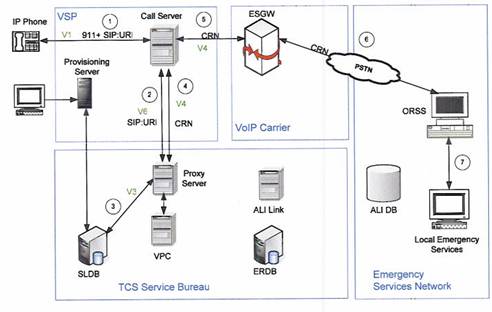
4
1.4.7 Service Confirmation
OUT OF SCOPE
OUT OF SCOPE
TCS will provide Vonage a custom i1 solution whereby all i1 calls route to the ORSS. The ORSS will confirm the caller’s location and route the call to the appropriate PSAP.
|
TCS |
|
Vonage |
|
• Provides ORSS for VoIP 9-1-1 service for calls within the United States and Canada. • Provides multiple 10-digit 24x7 PSAP emergency numbers for routing the call. |
|
• Directly routes 9-1-1 calls from Soft-switch to ORSS |
|
TCS |
|
Vonage |
|
• Provides VoIP E9-1-1 service for calls within the United States and Canada. • Provides a 10-digit 24x7 PSAP emergency number for routing the call. |
|
• Provides the call connectivity access to the PSTN. • a Provides softswitch with PSTN access. |
|
TCS/ ORSS |
|
Vonage |
|
• Confirms caller address • Identifies the type of emergency • Identifies the appropriate PSAP/ 1st Responder to handle the call • Contacts the PSAP/ 1st responder • Confirms call acceptance and drops from the call • Documents call status |
|
• Routes call via PSTN to the 10-digit number for the ORSS
• Establishes and maintains dedicated trunking between softswitch and PSTN. |
5
1.5.4 Data Delivery
|
TCS |
|
Vonage |
|
• Stages records in TCS database for reporting and billing purposes. |
|
|
As with all i1 calls, in the event that TCS receives a subscriber telephone number that is not in the SLDB, TCS will provides a 10-digit 24x7 ORSS number for routing the call. The ORSS will have the ability to validate the caller’s address and correlate that location to the most appropriate PSAP for handling the call.
OUT OF SCOPE
VoIP E9-1-1 Program Management Overview
When deploying TCS’ VoIP E9-1-1 solution, TCS provides project management, technical integration services, and data provisioning services. Throughout this process, TCS works closely with the VoIP provider’s team, PSAPs, and LECs.
Project management continues throughout the initial deployment process and is handled by a deployment manager. The project manager guides the VoIP provider through the VoIP E9-1-1 deployment and coordinates activities with all parties, including the LEC, PSAP, and the ALI database provider, from pre-kickoff to testing, to go live.
Data provisioning services begin as soon as the VoIP provider signs up. Data from the VoIP provider, the LEC’s selective router, the wireline ALI database, and the VPC must be provisioned to allow the PSAP to receive the proper data in the expected fields when an E9-1-1 call is delivered.
|
Event |
|
TCS |
|
Vonage |
|
Kickoff meeting |
|
• Scope • Resources • POC • Coordinate meeting with all required parties • Establish integration schedule |
|
• Attend meeting |
|
|
|
|
|
|
|
Test Connectivity between Vonage and TCS |
|
• Test IP connectivity with Vonage |
|
• Provide data necessary for IP connectivity over the internet • Provide test personnel as required |
|
|
|
|
|
|
|
ORSS Deployment |
|
• Test connectivity • Deploy solution to support call service • Schedule test calls and provide |
|
|
6
|
|
|
conference bridge • Conduct Test Calls |
|
|
|
|
|
|
|
|
|
Testing |
|
• Schedule testing with all parties • Oversee testing and troubleshooting |
|
• Provide test personnel • Provide subscriber data • Assist in troubleshooting • Provide resources for acceptance testing |
TCS VoIP E9-1-1—Operational Services Overview
TCS provides carriers with continuous availability of systems, seven days a week, 365 days a year. Using highly available facilities to maintain the high standards necessary for emergency services, TCS follows detailed provisioning and operations procedures to maintain network integrity. TCS designs, builds, and provisions its systems to be reliable, highly available, auto aware, and fault resilient. TCS Operations builds and monitors its systems in a production environment.
This section provides an overview of TCS facilities, and describes the connectivity, monitoring, incident management, change control, and reporting that occurs within Operations.
TCS operates highly available data centers and two network operations centers.
TCS has two data centers, located in Seattle, Washington, and Phoenix, Arizona; each is equipped with the same software and hardware. Each has secure, monitored access, an uninterruptible power supply, an on-site diesel generator, redundant systems, and network management servers. Each physically mirrors the other, so staff can quickly locate and access cabling and equipment in the event of an emergency.
All critical power systems are backed up by an uninterruptible power supply (UPS).
If the data center electrical load is interrupted, the UPS assumes the load during the brief time needed for the automatic transfer switch (ATS) to transfer the load to the generator.
Both data centers are protected by two fire suppression systems, the Inergen inert gas system, and a water sprinkler system.
1.7.2 Network Operations Centers
TCS maintains two Network Operations Centers (NOCs), located in Seattle, Washington, and Annapolis, Maryland. The Seattle facility monitors all system events 24 hours a day, 365 days a year. The Annapolis facility serves as a backup.
The NOC is responsible for identification, troubleshooting, internal and external notification of incidents, incident management, and problem resolution.
7
Every call event, including call origination, call completion, call control messages, data translations, and ALI database data delivery, is tracked.
NOC tools are designed and implemented in a geo-redundant manner visible from Seattle and Annapolis. Staff in both locations are trained to monitor and troubleshoot the E9-1-1 production systems and networks.
A comprehensive disaster recovery plan is in place that details procedures, processes, and training. In the event of a catastrophic failure in the Seattle NOC, the Annapolis NOC provides backup and resumes operation of the system as the primary NOC.
A resource will be identified to handle support issues during the ORSS IOT.
OUT OF SCOPE
Data and data relationships are a critical part of the TCS E9-1-1 Service.
Two unique data sets are necessary for service delivery—described below—each require specific data maintenance processes. TCS ensures data integrity on all four data sets, as well as performs back-up procedures on all databases.
|
Data Set |
|
Description |
|
PSAP Data Maintenance |
|
TCS maintains an extensive PSAP database for the purpose of deploying and operating VoIP E9-1-1 services. The database includes contact, technical infrastructure, and boundary information for each PSAP in the United States. This information can change after a PSAP is receiving VoIP E9-1-1 services and periodically changes due to political or restructuring events. TCS maintains the PSAP database and incorporates changes to the data. TCS coordinates any changes that may impact an operational VoIP E9-1-1 system with the VoIP carrier and PSAP. |
|
Mapping Services |
|
The TCS Geographical Information Systems (GIS) department creates maps that represent the data maintained by TCS. TCS maintains all the data and systems required to ensure that the geographical information systems will be accurate. As with the underlying data source, all GIS data is kept strictly confidential, secure, and proprietary. |
8
|
Term of Service: |
|
1 year | ||||
|
|
|
| ||||
|
Set Up Fee: |
|
$* | ||||
|
|
|
| ||||
|
Monthly Recurring Fee |
|
Daily Bucket Amount selected by Customer from among the following | ||||
|
|
|
| ||||
|
|
|
100 calls per day: |
$ |
*/month |
|
|
|
|
|
|
|
|
| |
|
|
|
200 calls per day: |
$ |
*/month |
|
|
|
|
|
|
|
|
| |
|
|
|
300 calls per day: |
$ |
*/month |
|
|
|
|
|
|
|
|
| |
|
|
|
400 calls per day: |
$ |
*/month |
|
|
|
|
|
|
|
|
| |
|
|
|
500 calls per day: |
$ |
*/month |
|
|
|
|
|
|
|
|
| |
|
|
|
600 calls per day: |
$ |
*/month |
|
|
|
|
|
|
|
|
| |
|
|
|
700 calls per day: |
$ |
*/month |
|
|
|
|
|
|
|
|
| |
|
|
|
800 calls per day: |
$ |
*/month |
|
|
|
|
|
|
| |||
|
|
|
Vonage Initial Daily Bucket Amount is 400 calls per day. | ||||
|
|
|
| ||||
|
Bucket Overage Penalty |
|
20% per call prorated on a cost per call basis based on the currently subscribed bucket amount and 30 days per month (for example, the bucket amount for 400 calls per day equates to $* per call; penalty price per call equals $* * 1.2 = $* per call; thus 410 calls in a day would result in 10 additional calls billed at $* per call or $* penalty for the day). | ||||
|
|
|
| ||||
|
Change Fee |
|
For every increase in the bucket amount requested by Customer, $* per 100 calls per day (no charge for increases requested before June 10, 2005). | ||||
|
|
|
| ||||
|
Ramp-up Period Fees |
|
From June 15, 2005 through June 30, 2005 the cost per call will be $* and the Daily Bucket Amount will not apply. | ||||
|
Payment Terms: |
|
Net 30 days | ||||
|
|
|
| ||||
|
Service Availability: |
|
I-1 Call Flow with ORSS as per the Vonage Statement of Work: TCS i1 VoIP 9-1-1 Service For Vonage | ||||
|
Acceptance criteria: |
|
In accordance with Article 4 of the Master Sales Agreement. | ||||
|
|
|
| ||||
|
Milestones for Service Launch: |
|
| ||||
|
|
|
Milestone |
|
Date |
|
|
|
|
|
Contract Signing |
|
6/8/2005 |
|
|
* Confidential treatment has been requested. The redacted material has been separately filed with the Commission.
9
|
Milestones for Service Launch: |
|
|
|
|
|
|
|
|
|
Milestone |
|
Date |
|
|
|
|
|
Contract Signing |
|
6/8/2005 |
|
|
|
|
|
|
|
|
|
|
|
|
|
Master Services Agreement Signoff |
|
6/8/05 |
|
|
|
|
|
|
|
|
|
|
|
|
|
Operator Routing Support Service Interoperability Testing SOW signoff |
|
6/8/05 |
|
|
|
|
|
|
|
|
|
|
|
|
|
Determine ORSS market roll-out schedule |
|
6/10/05 |
|
|
|
|
|
|
|
|
|
|
|
|
|
TCS to establish ramp-up feasibility, scope and schedule leading to launch |
|
6/10/05 |
|
|
|
|
|
|
|
|
|
|
|
|
|
Vonage to choose Daily Bucket Amount for July 1 Launch |
|
6/10/05 |
|
|
|
|
|
|
|
|
|
|
|
|
|
TCS provide DIDs for 9-1-1 ORSS call routing |
|
6/15/05 |
|
|
|
|
|
|
|
|
|
|
|
|
|
Establish interim i1 call routing from Vonage to ORSS |
|
6/13/05 |
|
|
|
|
|
|
|
|
|
|
|
|
|
Receive completed SoftSwitch configuration form |
|
6/15/05 |
|
|
|
|
|
|
|
|
|
|
|
|
|
Resolve general connectivity issues |
|
6/15/05 |
|
|
|
|
|
|
|
|
|
|
|
|
|
Integrate Soft Switch with TCS Network |
|
6/15/05 |
|
|
|
|
|
|
|
|
|
|
|
|
|
Acquire Test numbers from carrier |
|
6/15/05 |
|
|
|
|
|
|
|
|
|
|
|
|
|
Acquire Test phone from carrier |
|
6/15/05 |
|
|
|
|
|
|
|
|
|
|
|
|
|
Develop IOT Plan |
|
6/17/05 |
|
|
|
|
|
|
|
|
|
|
|
|
|
Deploy ORSS Tools |
|
6/24/05 |
|
|
|
|
|
|
|
|
|
|
|
|
|
Train Users |
|
6/29/05 |
|
|
|
|
|
|
|
|
|
|
|
|
|
IOT execution |
|
6/30/05 |
|
|
|
|
|
|
|
|
|
|
|
|
|
Notify customer of IOT completion and “service readiness” |
|
6/30/05 |
|
|
|
|
|
|
|
|
|
|
|
|
|
Establish final i1 call routing from Vonage to TCS to ORSS |
|
7/1/05 |
|
|
|
|
|
|
|
|
|
|
|
|
|
ORSS available for Vonage selected Daily Call Bucket |
|
7/1/05 |
|
|
Notes:
10
1. This Work Order is in accordance with Master Sales Agreement between TeleCommunication Systems, Inc. (“TCS”) and Vonage Network Inc. (“Vonage” or “Customer”) dated June 8, 2005, and constitutes Exhibit B thereto.
2. Unless otherwise expressly agreed in writing, no rights with respect to intellectual property are granted by either Party to the other Party
3. Vonage is responsible for all connectivity charges between TCS and Vonage.
|
TeleCommunication Systems, Inc. |
CUSTOMER | ||||||||||
|
|
| ||||||||||
|
By: |
|
/s/ Richard A. Young |
|
By: |
|
/s/ John S. Rego |
| ||||
|
Signature |
Signature | ||||||||||
|
|
| ||||||||||
|
|
Richard A. Young |
|
|
John S. Rego |
| ||||||
|
Name |
Name | ||||||||||
|
|
| ||||||||||
|
|
Exec. VP & COO |
|
|
CFO |
| ||||||
|
Title |
Title | ||||||||||
|
|
| ||||||||||
|
|
June 8, 2005 |
|
|
| |||||||
|
Date |
Date | ||||||||||
11
|
TeleCommunication Systems, Inc. |
|
Western Office |
|
2401 Elliott Avenue, Second Floor |
|
Seattle, WA 98121 |
|
Phone 206-792-2000 |
|
Fax 206-792-2051 |
|
www.telecomsys.com |
|
|
TeleCommunication |
|
|
Systems |
|
|
Enabling Convergent Technologies® |
|
TCS VoIP i1 9-1-1 Statement of Work |
|
Onsite Project Manager Work Order |
|
For Vonage Network Inc. |
EXHIBIT C TO MASTER SALES AGREEMENT
6/23/05
|
CONFIDENTIAL & PROPRIETARY |
1
|
Contents |
|
| |
|
|
| ||
|
1. |
INTRODUCTION |
3 | |
|
2. |
VOIP E9-1-1 PROGRAM MANAGEMENT OVERVIEW |
3 | |
|
3. |
SCHEDULE OF TASKS |
4 | |
|
4. |
ROLES AND RESPONSIBILITIES |
5 | |
|
|
4.1 |
TCS ONSITE PROJECT MANAGER |
5 |
|
|
4.2 |
VONAGE |
5 |
|
5. |
BILLING |
5 | |
2
1. Introduction
This document is Exhibit C to the Master Sales Agreement between TCS and Vonage dated June 8, 2005. This Statement of Work describes the roles and responsibilities of the Onsite Project Manager.
2. VoIP E9-1-1 Program Management Overview
When deploying TCS’ VoIP E9-1-1 solution, TCS will provide on-site project management, technical integration services, and data provisioning services pursuant to this Statement of Work at office facilities to be provided by Vonage. Throughout this process, TCS will work closely with the Vonage team, PSAPs, and LECs.
Services included in the charges for this Exhibit (as more specifically set forth below) are as follows:
1. TCS will guide Vonage through the VoIP E9-1-1 deployment and will coordinate activities with all parties, including the Third Party Call Delivery Provider (e.g. CLEC), LEC, PSAP, and the ALI database provider, from pre-kickoff to testing, to go live.
2. Manage the process whereby TCS will provide data provisioning services (under a separate Statement of Work/Work Order) which will process data from Vonage, the LEC’s selective router, the wireline ALI database, and the VPC in such a manner as to allow the PSAP to receive the proper data in the expected fields when an E9-1-1 call is delivered.
The Services described above will continue throughout the term set forth below and will be performed by a TCS-employed project manager (the “Onsite Project Manager”), who will deploy TCS resources as reasonably appropriate to accomplish these tasks. The Onsite Project Manager shall not be deemed to be an employee of Vonage for any purpose. The Onsite Project Manager’s efforts will be devoted full time to the services to be provided under this Exhibit and will be performed within Vonage’s premises, except to the extent requested or approved by Vonage. For the avoidance of doubt, TCS shall be solely responsible for the Onsite Project Manager’s employment and related compensation, benefits and taxes, and for maintaining worker’s compensation and other employment-related insurance.
TCS has designated Lynne Fleck to serve as the Onsite Project Manager for this effort. Except for circumstances outside the control of TCS, Ms. Fleck shall not be removed from the project or otherwise reassigned without the written approval of Vonage, which may be withheld in Vonage’s sole discretion. If circumstances arise which are outside the control of TCS that result in Ms. Fleck not being able to continue to serve as the Onsite Project Manager, TCS agrees to assign a substitute project manager who possesses qualifications and experience similar to those offered by Ms. Fleck, subject to the reasonable approval of Vonage.
TCS warrants that all services provided hereunder will be performed in a professional, workmanlike manner and in accordance with industry standards for such services.
3
3. Schedule of Tasks
|
Event |
|
TCS |
|
Vonage | ||
|
Kickoff meeting |
|
o |
Scope |
|
o |
Attend meeting |
|
| ||||||
|
o |
Resources | |||||
|
| ||||||
|
o |
POC | |||||
|
| ||||||
|
o |
Coordinate meeting with all required parties | |||||
|
|
| |||||
|
o |
Establish integration schedule | |||||
|
|
|
|
|
| ||
|
Test Connectivity between Vonage and TCS |
|
o |
Test IP connectivity with Vonage |
|
o |
Provide data necessary for IP connectivity over the internet |
|
o |
Provide test personnel as | |||||
|
|
|
|
|
| ||
|
ORSS Deployment |
|
o |
Test connectivity |
|
| |
|
|
| |||||
|
o |
Deploy solution to support call service | |||||
|
|
| |||||
|
o |
Schedule test calls and provide conference bridge | |||||
|
|
| |||||
|
o |
Conduct Test Calls | |||||
|
|
|
|
|
| ||
|
Testing |
|
o |
Schedule testing with all parties |
|
o |
Provide test personnel |
|
|
| |||||
|
o |
Provide subscriber data | |||||
|
|
| |||||
|
o |
Assist in troubleshooting | |||||
|
|
| |||||
|
o |
Provide resources for acceptance testing | |||||
4
4. Roles and Responsibilities
4.1 TCS Onsite Project Manager
|
Roles and Responsibilities | |
|
• |
Provide direction to customer regarding deployment services, roles, responsibilities and strategies for PSAP management. |
|
• |
Advise customer on organization and management of PSAP service team |
|
• |
Provide public safety expertise |
|
• |
Act as liaison to TCS for Vonage |
|
• |
Communicate overall deployment status to Vonage |
|
• |
Assist Vonage with issues related to the ORSS and Service Bureau operations |
|
• |
Provide a single point of contact for all issues |
4.2 Vonage
|
Roles and Responsibilities | |
|
• |
Provide a single point of contact for all issues |
5. Billing
|
Term of Service: |
Six (6) months from the Start Date, which may be extended at Vonage’s option on a month-to-month basis; Vonage may terminate this Statement of Work for convenience on thirty (30) days’ notice. | |
|
|
| |
|
Start Date: |
July 1, 2005 | |
|
|
| |
|
Monthly Rate: |
$* | |
|
|
| |
|
Expenses: |
Travel and incidentals that have been approved in writing in advance by Vonage, billed monthly in arrears. | |
|
|
| |
|
Payment Terms: |
Net 30 days | |
|
|
| |
|
Milestones for Service Launch: |
Milestone |
Date |
|
|
|
|
|
|
SOW Signing |
6/15/2005 |
* Confidential treatment has been requested. The redacted material has been separately filed with the Commission.
5
Notes:
1. This Statement of Work is in accordance with Master Sales Agreement between TeleCommunication Systems, Inc. (“TCS”) and Vonage Network Inc. (“Vonage” or “Customer”) dated June 8, 2005, and constitutes Exhibit C thereto.
2. Unless otherwise expressly agreed in writing, no rights with respect to intellectual property are granted by either Party to the other Party.
AGREED:
|
TeleCommunication Systems, Inc. |
|
Vonage Network Inc. | ||||
|
|
|
| ||||
|
By: |
/s/ Richard A. Young |
|
|
By: |
/s/ Louis Mamakos |
|
|
Signature |
|
Signature | ||||
|
|
|
| ||||
|
Richard A. Young |
|
|
Louis Mamakos |
| ||
|
Name |
|
Name | ||||
|
|
|
| ||||
|
Exec. Vice President & COO |
|
|
Chief Technology Officer |
| ||
|
Title |
|
Title | ||||
|
|
|
| ||||
|
27 June 2005 |
|
|
24 June 2005 |
| ||
|
Date |
|
Date | ||||
6
TeleCommunication Systems, Inc,
Western Office
2401 Elliott Avenue, 2nd Floor
Seattle, WA 98121
Phone 1 206-792-2000
Fax +1 206-792-2001
www.telecomsys.com
TeleCommunication Systems
Enabling Convergent Technologies®
TCS VoIP E9-1-1
PSAP Outreach Activities Statement of Work
For Vonage Network Inc.
Exhibit D
07/27/05
|
1.0 |
|
Introduction |
|
1 | ||
|
|
|
|
|
| ||
|
|
|
1.1 |
|
PSAP Outreach Activities |
|
1 |
|
|
|
|
|
|
|
|
|
2.0 |
VoIP PSAP Outreach Process Summary |
|
1 | |||
|
|
|
|
| |||
|
|
|
2.1 |
|
Activities to be completed by TCS |
|
1 |
|
|
|
|
|
|
|
|
|
|
|
2.2 |
|
Activities to be completed by ESGW provider |
|
2 |
|
|
|
|
|
|
|
|
|
3.0 |
Reporting |
|
4 | |||
|
|
|
|
| |||
|
4.0 |
Pricing and Billing |
|
4 | |||
|
|
|
|
| |||
|
5.0 |
AGREED: |
|
6 | |||
i
1.0 Introduction
1.1 PSAP Outreach Activities
This document is Exhibit D to the Master Sales Agreement between TCS and Vonage dated June 8, 2005. In order to quickly secure agreement to i2 deployment and collect information required to deploy, it is necessary to launch an aggressive PSAP Outreach campaign as soon as possible. Outreach activities include written documentation, education, verbal communication and hand-off to deployment personnel.
The following process summary outlines all steps required to complete these activities, along with agreed-upon deliverables, timelines and roles and responsibilities. For purposes of this Exhibit D, the term “VSP” shall refer to Vonage.
2.0 VoIP PSAP Outreach Process Summary
Assumptions:
• PSAP Outreach activities do not include those required to determine areas of common coverage between VSP, TCS, ESGW or priority to contact. It is assumed that this process will be in-progress or completed prior to PSAP outreach, as this information is needed to prioritize order of PSAP contact.
• PSAP Outreach activities do not include those required to deploy each PSAP.
2.1 Activities to be completed by TCS
|
Master Task |
|
VoIP TCS/VSP Welcome Kit/Checklist | |
|
Sub Task |
|
Create VoIP Welcome Kit | |
|
Deliverable |
|
Welcome Kit | |
|
Description |
|
Create VoIP welcome kit for mass-distribution to all PSAPs on list to deploy, subject to written approval by Vonage. | |
|
Purpose |
|
Kit to include introduction to VoIP, VSP and to provide advance notice of additional deployment activities by TCS. | |
|
Timeline |
|
First draft to be completed by 07/26, revised and ready to produce by 07/29. | |
|
|
|
| |
|
Master Task |
|
VoIP TCS/VSP Welcome Kit/Checklist | |
|
Sub Task |
|
Produce and Send VoIP Welcome Kit | |
|
Deliverable |
|
Kit sent to PSAP | |
|
Description |
|
VoIP Welcome Kits developed as set forth above will be produced and sent to PSAP in phases in accordance with the Vonage/TCS mutually-agreed determined priority to deploy. | |
|
Purpose |
|
To quickly notify all PSAPs of VSP’s intent to deploy and forthcoming deployment activity. | |
|
Timeline |
|
Beta version of kit to be produced by 07/22 for review during State/PSAP/APCO/NENA meetings facilitated by Vonage regulatory staff through 08/10. Proposed schedule for kit distribution: | |
|
|
|
• |
500 kits sent 08/15 |
|
|
|
• |
500 kits sent 08/22 |
|
|
|
• |
500 kits sent 08/29 |
|
|
|
• |
an additional 1500 PSAPs kits will be sent between 09/15 and 09/29. |
1
|
Master Task |
|
PSAP interview |
|
Sub Task |
|
Initial PSAP Contact |
|
Deliverable |
|
Complete or schedule PSAP Interview |
|
Description |
|
Contact PSAPs in order of Vonage/TCS mutually-agreed deployment schedule. TCS will attempt to immediately reach the primary POC at PSAP and complete interview. If POC is unavailable, TCS will make all reasonable efforts to secure date/time for PSAP interview as soon as possible. |
|
Purpose |
|
Make initial contact with PSAP to notify of i2 deployment and collect information needed for deployment. |
|
Timeline |
|
Within 21 days of Welcome Kit delivery. |
|
Master Task |
|
PSAP Interview |
|
Sub Task |
|
i2 education |
|
Deliverable |
|
Review PSAP VoIP kit and describe to PSAP POC the process of i2 VoIP deployment activities and impact. |
|
Description |
|
Review and discuss i2 deployment w/PSAP. |
|
Purpose |
|
Education of PSAPs to enable quick collection of PSAP information and deployment of i2 service. |
|
Timeline |
|
1 business day for each PSAP, all to be completed as set forth in Section 4.0. |
|
Master Task |
|
PSAP Interview |
|
Sub Task |
|
Obtain VoIP MSAG, ESN and CRN (Note: Due to the relationship between ESN and Shell Record, these should be collected by the same party concurrently). |
|
Deliverable |
|
VoIP shell record (default record in ALI database for ESQK values assigned). |
|
Description |
|
Obtain shell record for all PSAPs that have agreed to accept i2 VoIP service. |
|
Purpose |
|
Enable TCS to provision ALI with VoIP shell record. |
|
Timeline |
|
If not immediately available, request information to be provided within 3 business days of PSAP interview; all to be completed as set forth in Section 4.0. |
|
Master Task |
|
PSAP Interview |
|
Sub Task |
|
Review VoIP routing boundary |
|
Deliverable |
|
PSAP Agreement with geographic VoIP Routing Boundary provided by TCS. |
|
Description |
|
Confirm whether PSAPs VoIP call routing boundary will be the same as their wireless boundary or if they want routing based on wire line boundary. |
|
Purpose |
|
Establish correct routing for i2 calls. |
|
Timeline |
|
During PSAP interview. If PSAP opts to provide new boundary, collect within 3 business days of interview; all to be completed as set forth in Section 4.0. |
|
Sub Task |
|
Build PSAP deployment record in status-tracking system. |
|
Deliverable |
|
PSAP deployment record associated with deployment tasks required for VoIP deployment. Hand-off to VoIP deployment team. |
|
Description |
|
TCS PSAP data team to build PSAP record, document information provided by VSP. |
2
|
Purpose |
|
To facilitate hand-off between TCS PSAP Outreach team and deployment to begin VolP deployment process. To capture PSAP-related information in a single-place to facilitate deployment activity and status reporting. |
|
Timeline |
|
Within 1 day of each PSAP i2 acceptance, all to be completed as set forth in Section 4.0. |
|
Master Task |
|
PSAP acknowledges Vonage’s intent to deploy and provides/agrees to provide VoIP shell record. |
|
Sub Task |
|
Send VoIP Deployment Confirmation letter. |
|
Deliverable |
|
Confirmation letter to PSAP summarizing PSAP interview and set expectation for collecting outstanding items from PSAP. |
|
Description |
|
Send Deployment Confirmation Letter to PSAP. |
|
Purpose |
|
To provide deployment confirmation to PSAP and set deployment timing expectations. |
|
Timeline |
|
Within 1 day of each PSAP i2 acceptance, all to be completed as set forth in Section 4.0. |
|
Master Task |
|
PSAP refuses i2 and will not provide VoIP shell record: |
|
Description |
|
Notify VSP PSAP liaison of PSAP refusal and reasons cited. |
|
Purpose |
|
Facilitate VSP-established escalation procedures and document PSAP cooperation for regulatory reporting purposes as requested by Vonage. |
|
Timeline |
|
Within 1 day of each PSAP’s refusal, all to be completed as set forth in Section 4.0. |
2.2 Activities to be completed by ESGW provider
ESGW provider must provide or collect the following information for PSAPs to be deployed. As a VPC, TCS does not have direct interaction with LECs and PSAPs regarding trunking and connectivity and, historically, cannot obtain this information without Letter of Agency. The party responsible for S/R and PSAP coverage must complete these tasks and report status of each to TCS.
|
Master Task |
|
Determine ESGW Coverage to specific PSAPs | |
|
Deliverable |
|
Confirmation that ESGW has connectivity to S/R serving PSAP and to specific PSAP. | |
|
Description |
|
VSP/ESGW provider to determine if current connectivity to PSAP exists. | |
|
Purpose |
|
TCS’ ability to manage timeline of PSAP deployment timeline is greatly impacted by ESGW coverage status. | |
|
Timeline |
|
Existing coverage status for to-deploy PSAPs to be determine in overall TCS/VSP/ESGW provider analysis. | |
|
|
|
• |
Additional coverage confirmation requests from TCS to be made to ESGW through a process to be agreed upon by the parties hereto. |
|
|
|
• |
New build-out coverage status to be communicated to TCS from ESGW provider through a process to be agreed upon by the parties hereto. |
3
|
Master Task |
|
Confirm PSAP Trunking Requirements | |
|
Deliverable |
|
Confirmation whether PSAP will use existing wireline/wireless trunks, or whether new VoIP trunking between PSAP and S/R is required. | |
|
Description |
|
ESGW provider to work with LEC/PSAP to determine if any change to existing trunking from PSAP to S/R is required. | |
|
Purpose |
|
TCS to manage PSAP deployment timeline according to trunking requirements. | |
|
Timeline |
|
• |
Requests for confirmation to be made by TCS to ESGW provider using a process to be agreed upon by the parties hereto. |
|
|
|
• |
Proactive confirmation of PSAP trunk status to be communicated to TCS from ESGW provider using a process to be agreed upon by the parties hereto. |
3.0 Reporting
TCS will provide to Vonage access to a web-based reporting server for access to all VoIP reports and data. Through this web site, TCS will report on PSAP Outreach Activities and Vonage will be able to access these reports. TCS will provide Vonage with the capability to access the following data:
|
Function |
|
Report |
|
PSAP |
|
PSAP Outreach Status • Not Started • Accepted/Confirm letter sent • Escalated to VSP PSAP team. • In Progress • Delay Welcome Kit Delivered |
4.0 Pricing and Billing
4.1 Full PSAP Outreach Service
Billing will be at a flat rate depending on the number of PSAPs selected for outreach activities. Invoices against the flat rate will be billed over four months, at the end of each month in the monthly amounts shown below, such that the total amount of the flat rate will be fully invoiced by the end of October 2005. Billing for the 2005 flat rate will commence immediately upon execution of this Exhibit D.
|
|
|
Monthly Invoice Schedule |
| ||||||||||||||||
|
# |
|
Total |
|
July 2005 |
|
August |
|
September |
|
October |
|
Cost / |
| ||||||
|
3000 |
|
$ |
* |
|
$ |
* |
|
$ |
* |
|
$ |
* |
|
$ |
* |
|
$ |
* |
|
Completion of the outreach activities for 3000 PSAPs will require 80 calendar days. Outreach activities for a smaller number of PSAPs will require less time.
* Confidential treatment has been requested. The redacted material has been separately filed with the Commission.
4
A proposed schedule is outlined in section 2.1 of this Exhibit.
Vonage and TCS shall mutually agree on a final schedule and list of PSAPs to be contacted within 10 days of the effective date of this Exhibit. The parties may mutually agree on revisions to this final schedule but no such revisions will be effective unless agreed upon by both parties in writing.
4.2 Partial PSAP Outreach Service
PSAP Outreach can be broken into two distinct sets of tasks. The first set of tasks includes preparing and sending Welcome Kits. The second set of tasks starts with the initial PSAP Contact (see section 2.1). Should Vonage choose to send additional PSAP Outreach Kits, this can be done without having to commit to purchasing full PSAP Outreach services. This cannot be done without purchasing the minimum (1000) amount of full service PSAP Outreach services.
Produce and Send VoIP Welcome Kit
The price for producing and sending welcome kits is as follows:
|
# |
|
Service Fee to produce |
|
Cost / |
| ||
|
500 |
|
$ |
* |
|
$ |
* |
|
This service must be ordered in a separate work order within 30 days of the effective date of this Agreement.
Perform Remaining Outreach Tasks
The price for performing remaining outreach tasks will be based on the price per additional PSAP as outlined in section 4.1 less the $30 paid for producing and sending VolP Welcome Kits. This service can be ordered in batches of 50. The cost per PSAP is based upon the contract rate for full Outreach Services (see section 4.1).
|
# PSAPS |
|
# PSAPS |
|
Service Fee to perform |
|
Cost / |
| ||
|
3000 |
|
50 |
|
$ |
* |
|
$ |
* |
|
This service must be ordered in a separate work order within 45 days of the effective date of this Agreement.
* Confidential treatment has been requested. The redacted material has been separately filed with the Commission.
5
5.0 AGREED:
|
TeleCommunication Systems, Inc. |
Vonage Network Inc. | ||||
|
|
| ||||
|
|
| ||||
|
BY: |
/s/ Bruce A. White |
|
BY: |
/s/ Louis Mamakos |
|
|
Signature |
Signature | ||||
|
|
| ||||
|
Bruce A. White |
|
Louis Mamakos |
| ||
|
Name |
Name | ||||
|
|
| ||||
|
Vice President |
|
Chief Technology Officer |
| ||
|
Title |
Title | ||||
|
|
| ||||
|
29 July 2005 |
|
28 July 2005 |
| ||
|
Date |
Date | ||||
6